Museveni warns leaders against non-performance, calls for full transformation into money economy
He said this early exposure shaped his understanding of transformation from okukolera ekidda kyoonka [working only for the stomach] into a money economy.

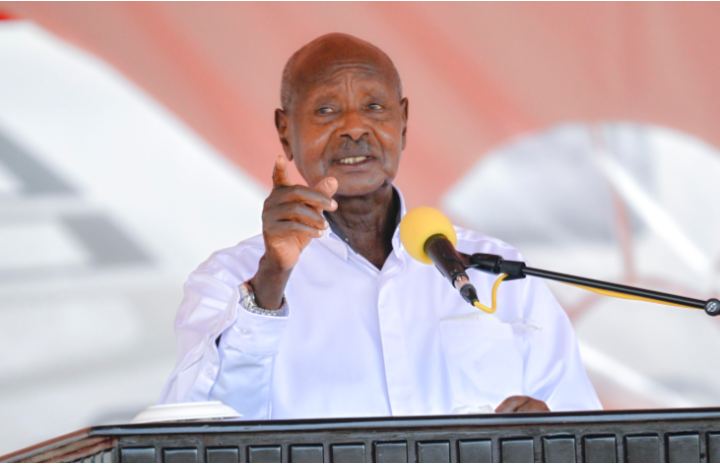

Kampala: President Yoweri Kaguta Museveni has today used the State of the Nation Address 2026 at Kololo Independence Grounds to issue a strong call to leaders and citizens to intensify efforts in Uganda’s economic transformation.
He warned against non-performance, corruption and diversion from productive work.
During the event, the President addressed Members of Parliament and senior government officials, as well as the nation through a hybrid format, saying Uganda’s progress depends on discipline in leadership and the full participation of citizens in the money economy through structured production and wealth creation.
He also thanked Ugandans for participating in the electoral process since January 15, 2026, and for their support to the ruling National Resistance Movement, before turning to what he described as the core challenge facing the country; the need to eliminate economic and leadership inefficiencies.
“Above all, I thank God for all these victories and for the peace in the Country in spite of so many evil people that have been plotting to disturb the peace.”

President Museveni further warned against tolerance of weak execution of mandate in both the government and communities, arguing that Uganda cannot achieve transformation if leaders fail to guide citizens into productive work.
He used his longstanding mobilisation message to reinforce this point, clarifying what he called distortions of his earlier remarks.
“During the presidential inauguration, I put forward a call for “no more sleep.” Some people are already distorting it as just “no sleep.” To clarify the message: it means no more sleep, no more corruption, no more diversions, no more politeness for non-performers who want leadership positions for ego and personal intentions,” he said.

The President said Uganda’s development path has always been about shifting people from subsistence living into structured economic participation, arguing that the biggest challenge has been moving households into the money economy.
He traced this thinking back to the early development debates of the 1960s, saying the country’s economic structure at the time was largely a subsistence system that kept citizens outside meaningful production for markets.
The President explained that by the mid-1960s, ideas on transformation had begun to crystallise, later forming part of the 10-point programme, whose fifth point focused on “building an independent, integrated, self-sustaining national economy.”
A significant part of the address focused on the cattle corridor, where the President said early mobilisation efforts aimed at transforming nomadic pastoralists into settled commercial farmers had yielded lasting results.
He also added his early personal experience in the cattle corridor, recalling that as a young student he moved through areas such as Ntungamo, Mbarara and Nyabushozi engaging communities and observing subsistence production systems.
He said this early exposure shaped his understanding of transformation from okukolera ekidda kyoonka [working only for the stomach] into a money economy.
He said those early engagements later evolved into structured mobilisation work, where communities were encouraged to shift from nomadism to enclosed farming and commercial production guided by calculation and profit, which he referred to as ekibaro.
The President recalled that “Between 1966 and 1986, in spite of the wars, we sensitized people about abandoning nomadism for sedentary agriculture.”
He noted that over time, households in areas such as Nyabushozi embraced commercial agriculture, particularly dairy farming, which has become a major driver of rural incomes.
He said milk production has increased from about 200 million litres in 1986 to 5.4 billion litres today, describing this as evidence of successful integration into the money economy.
“That was all. They converted their indigenous Ankole cattle into half-breeds with the Friesians (ebiihwa) and they took off.”
The President noted that this transformation did not happen without resistance, saying early scepticism from professionals questioned whether rural communities could shift from subsistence livelihoods to commercial production. However, he said results have since proven otherwise.
He reflected on early mobilisation efforts carried out with limited resources during the struggle period, saying that ideas rather than money, drove the movement that later shaped national policy direction.
President Museveni said these efforts eventually contributed to the formation of the National Resistance Movement, which he said was built on analysis of Uganda’s economic challenges and practical solutions rather than financial mobilisation.
Turning to implementation, the President said government programmes such as the Parish Development Model, Emyooga, NAADS and Operation Wealth Creation are designed to extend this transformation to all households, enabling citizens to participate in structured production.
He said these programmes are meant to support households in entering the money economy, but stressed that their success depends on discipline, proper implementation and responsible leadership at all levels.
The President also highlighted the importance of infrastructure development, including roads, electricity and transport systems, saying these are essential foundations for industrialisation and market access.
He said Uganda’s electricity generation has increased from about 60 megawatts in 1986 to over 2,000 megawatts today, describing this as a key enabler of production and industrial growth.
On economic performance, the President said Uganda has recorded significant progress in GDP growth, poverty reduction, improved life expectancy and expansion of exports, noting that the country has transitioned into a lower middle-income economy.
He said Uganda’s economy has undergone what he described as multiple phases of transformation, driven by recovery, expansion, diversification, value addition and movement into knowledge-based production.
The President further emphasized the need for broader markets, arguing that Uganda’s internal market alone is insufficient to sustain long-term growth, and calling for deeper regional and continental economic integration.
He said Africa’s economic future depends on integration, adding that expanded markets are necessary to absorb increasing production and support sustained prosperity.
To non-performers, President Museveni warned that if they cannot fulfil their mandate, they should leave leadership.
“Either you lead or you stay in your home. I hear of leaders talking about allowances, to reach their people and mobilise them against poverty, I get nauseous. Out of politeness, I’ve been keeping quiet but now I’m telling you. All non-performers must leave leadership,” he said.
“This is the time to talk straight to everyone. Why should a Muluka chief (a local-level administrative leader) ask for a motorcycle to do his work? Let him ride a bicycle, it is better for him and he will live longer. I’m really sick and tired of parasitism and that’s why I said; in this kisanja no more sleep.”
The President concluded his address by reinforcing the central message of discipline, productivity and accountability in leadership, urging leaders to ensure that government programmes deliver real results at household level and contribute to Uganda’s long-term economic transformation.
On his part, the Speaker of Parliament, Rt. Hon. Jacob Oboth Oboth notified Members of Parliament of the President’s Constitutional obligation to hold the State of the Nation Address highlighting key national achievements, pressing challenges and drawing of Parliament’s legislative agenda as it commences its business.
He rallied MPs to ensure cohesion, hardwork and prioritize their electorate as they undertake their mandate with guidance from the President’s State of the Nation Address to Parliament.
The Speaker also affirmed Parliament’s focus and alignment of its undertakings towards Uganda’s tenfold economic growth target of USD500 billion.
The event was also attended by the Vice President, H.E Jessica Alupo, Prime Minister, Rt. Hon. Robinah Nabbanja, Ministers, among other dignitaries.
Do you have an advertisement or article you want to publish? Mail us at theugreports@gmail.com or WhatsApp +256757022363.