MUTSA trains Masindi learners to make reusable sanitary pads
"This training has raised the learners' self-esteem and will help keep them in school. We shall continue training new learners so that the production of reusable sanitary pads becomes a sustainable programme at the centre," Rwamukaga said.

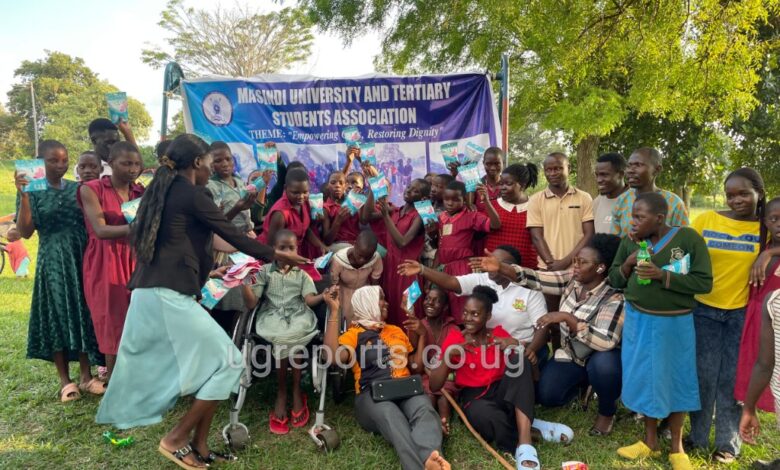

Masindi: Masindi University and Tertiary Students’ Association (MUTSA) has donated reusable sanitary pads and trained learners at Masindi Centre for the Handicapped in making reusable sanitary pads to improve menstrual hygiene and keep girls in school.
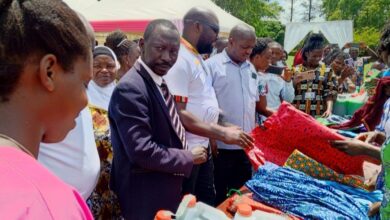
The training and donation exercise was held on Tuesday, July 28, 2026 at the centre in Bikonzi Sub-county, Bujenje County, Masindi District, where 60 pairs of reusable sanitary pads were distributed to learners.
Abraham Tumusiime, the MUTSA President said the initiative targeted learners with disabilities in a rural setting, where access to sanitary pads is often limited.
“We decided to donate reusable sanitary pads and train the learners on how to make them because many of them may not be able to afford disposable pads. By learning this skill, they can make their own and maintain proper hygiene,” Tumusiime said.
Swabra Katusiime, Founder of She Cares Foundation, said the partnership with MUTSA seeks to reduce absenteeism among school-going girls caused by a lack of menstrual hygiene products.

“Many girls miss classes because they cannot afford sanitary pads. Teaching them to make reusable pads will help them stay in school and complete their education,” she said.
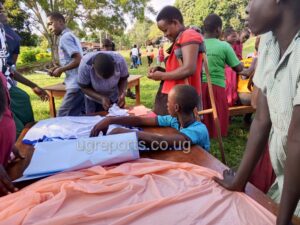
Ignatius Ahumuza, the Chairperson of the Western Cluster at the Young African Leaders Initiative (YALI) said such skills empower girls to remain in school during their menstrual periods.
“Parents should support their daughters by providing basic necessities like sanitary pads because many girls continue to miss school during menstruation,” Ahumuza said.

Nottie Karen Asiimwe, a trainer said the materials used to make reusable pads are readily available in local markets and emphasized proper hygiene practices when using them.
“We have trained the learners on how to make, use and properly clean reusable sanitary pads. We hope they will also pass on this knowledge to their fellow learners and communities,” Asiimwe said.
She also appealed to parents to prioritize menstrual hygiene needs for their daughters. “I appeal to parents to provide for their children, especially girls, because many miss lessons during their menstrual periods,” she added.
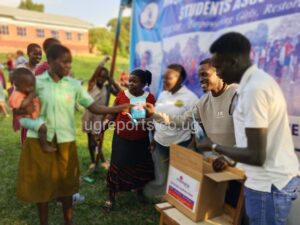
Samuel Rwamukaga, the Director of Studies at Masindi Centre for the Handicapped, commended MUTSA and its partners for the initiative, saying it will help learners focus on their education while acquiring a practical life skill.
“This training has raised the learners’ self-esteem and will help keep them in school. We shall continue training new learners so that the production of reusable sanitary pads becomes a sustainable programme at the centre,” Rwamukaga said.
Rwamukaga noted that the school’s tailoring section will continue producing reusable sanitary pads for fellow learners and surrounding communities, helping families save money while promoting better hygiene.
The Masindi Centre for the Handicapped has an enrollment of 185 learners, although only 112 are currently at school, with the rest staying at home due to health-related complications.
Do you have an advertisement or article you want to publish? Mail us at theugreports@gmail.com or WhatsApp +256757022363.

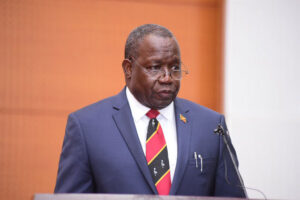


Together let’s break the stigma and create an environment where girls and women can access sanitary towels #endperiodpoverty