Poor health services, land evictions top complaints at Kiryandongo anti-corruption caravan
"The hospital has many broken and old beds, the wards were dirty, waste disposal was poorly managed and the dental clinic is operating with outdated facilities," Paul said.

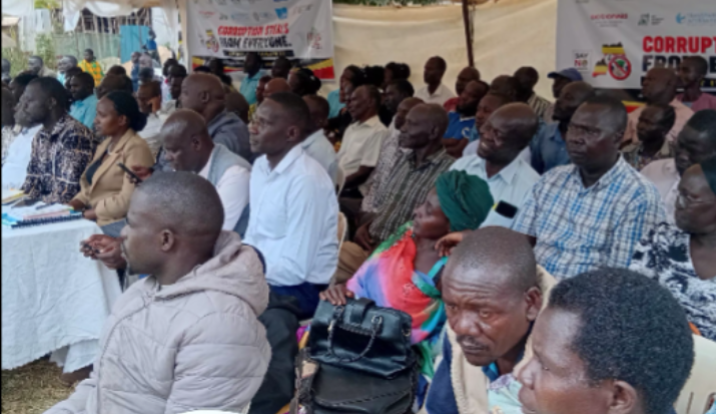

Kiryandongo: Corruption, poor health services, high electricity connection costs, land conflicts and alleged extortion in public institutions dominated discussions at an Anti-Corruption Baraza held on Monday at Bweyale Catholic Church Grounds in Kiryandongo District.
The Baraza, organized by the Inspectorate of Government (IG), brought together district leaders, security officials and residents to discuss corruption and service delivery challenges affecting communities.
Opening the meeting, Ogenyi Morris, the Executive Director of Alpha Action For Social Economic Development (AASED) described the gathering as an opportunity for citizens to openly raise concerns affecting the district.
“This is a platform used to bring out complaints about corruption in the district and Uganda at large so that appropriate action can be taken,” Ogenyi said.
Edward Oyengo, the LCIII Chairperson of Bweyale Town Council, reflected on the transformation of the area over the years and called for increased government support under the Parish Development Model (PDM).

“In 1986, Bweyale had only four buildings and four tribes Banyoro, Paluo, Acholi and Muyindi. Today the town has grown tremendously, and government should increase PDM funding to support more people,” Oyengo said.
Osaga Nelson, the Kiryandongo District LCV Chairperson, said the district leadership has received numerous complaints about public servants overstaying in the same offices, a practice he said fuels corruption.
“We are receiving many complaints about government workers staying in public offices for more than five years. The District Executive Committee will implement staff rotation as a mechanism to fight corruption across lower local governments,” Nelson said.

He singled out the land and judiciary sectors as some of the departments most affected by corruption and appealed to the Inspectorate of Government to support efforts aimed at resolving longstanding disputes.
A report presented by Otieno Paul, the Regional Inspectorate of Government Officer for Hoima, highlighted several shortcomings at Kiryandongo General Hospital following a recent inspection.
“The hospital has many broken and old beds, the wards were dirty, waste disposal was poorly managed and the dental clinic is operating with outdated facilities,” Paul said.
He also revealed that inspectors found no mortuary refrigerator for preserving bodies, patients paying Shs200 to use hospital toilets, and scan services being freely available only to pregnant women and children.
“The hospital administration needs to sensitize patients about which services are free and which require payment. There is also need to improve the dental clinic and other critical facilities,” he added.
Mustafa Wanda, a resident of Bweyale Town Council, said many households cannot afford the cost of power installation. “Electricity registration in Bweyale and Kiryandongo costs about Shs3 million, which is beyond the reach of ordinary residents,” Wanda said.
He also alleged widespread corruption at Bweyale Police Station and blamed insecurity on inadequate protection of government-funded projects.
“Corruption at Bweyale Police Station is too much, and many PDM projects are not adequately protected, exposing them to theft and vandalism,” he claimed.
Responding to the concerns, Steven Ojok, the Kiryandongo District Police Commander (DPC), emphasized that government remains committed to fighting corruption. “Government is very serious about fighting corruption and police bond is free. People should always report cases of corruption whenever they encounter them,” Ojok said.
On insecurity, he attributed the challenge to the district’s rapidly growing population.
“Criminality has increased due to population pressure, but additional police personnel will be deployed next week to strengthen security in Bweyale Town,” he said.
However, LCV Chairperson Osaga challenged the police to improve their response to public concerns.
“The police should style up and respond effectively to issues raised by residents instead of appearing to hide the challenges people are facing,” Nelson said.
Employment-related corruption also featured prominently during the discussions.
Amonyi Faith Kiki Chwabujingo, a widow, alleged that her daughter failed to secure employment after being asked to pay a bribe.
“My daughter was asked to pay Shs500,000 to get a job, but she could not afford it,” she said.
Meanwhile, Obeleng Leo Michael accused some government schools of illegally charging fees despite government policies providing free education.
“There is extortion through school fees in government schools where parents are required to pay money every term,” he alleged.
In response, Katusabe Johnson, the Senior Inspector of Schools, dismissed the practice as unauthorized. “Kiryandongo District has a school feeding programme and government schools are not supposed to charge school fees. I will investigate the allegations raised,” Johnson said.
Land disputes and evictions also emerged as major concerns.
Frank Nkurunziza, a resident of Kimogoro, accused Kiryandongo Sugar Factory of destroying his property while he was hospitalized and failing to compensate him.
“All my property was destroyed while I was admitted in hospital and I have never been compensated. I sought help from leaders from LC1 up to the RDC, but I was only advised to go to court,” Nkurunziza said.
Addressing concerns over the Parish Development Model, Jonathan Akwetereho, the Deputy Resident District Commissioner (RDC) for Kiryandongo, acknowledged that some irregularities had occurred during implementation.
“The allegations regarding PDM are true. Several staff members have been interdicted and beneficiaries are now receiving the full Shs1 million allocated under the programme,” Akwetereho said.
On land conflicts, he blamed persistent disputes on weaknesses in land administration and alleged impunity involving some institutions and private companies.
“The root cause of many land disputes is poor land administration. Government should thoroughly examine the operations of the Uganda Land Commission and other relevant institutions,” he said.
The Deputy RDC also warned residents against illegal acquisition of land and national identity cards by refugees, emphasizing the importance of integrity, honesty, transparency and accountability in the fight against corruption.
The Baraza concluded with commitments from district leaders and government officials to follow up on concerns raised regarding hospital conditions, police accountability, land conflicts and the monitoring of Parish Development Model funds.
Do you have an advertisement or article you want to publish? Mail us at theugreports@gmail.com or WhatsApp +256757022363.