President Museveni hails East Africa Revival for transforming Ankole
He also recalled returning to Ankole with his parents and sister, Dr. Kajubiri, in 1949 during celebrations to mark 50 years of the Church's presence in the region.


Mbarara: President Yoweri Kaguta Museveni has hailed the East African Revival for its contribution to the moral, social and economic transformation of Ankole over the past 90 years.
President Museveni said the Revival helped communities confront social challenges including alcoholism, adultery, dishonesty, poor hygiene, superstition and harmful traditional practices, while promoting education, discipline and responsible Christian living.
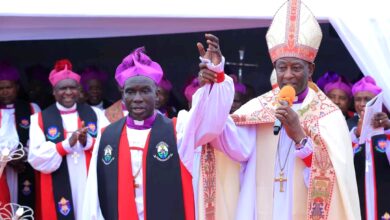
He made the remarks today at St. John’s Cathedral, Ruharo, in Mbarara City, during celebrations marking 90 years of the East African Revival in Greater Ankole.
The five-day Ankole Revival Convention was held under the theme, “Jesus Christ is the same yesterday, today and forever,” drawn from Hebrews 13:8.
The East African Revival, which took root in Ankole in 1936, was a spiritual movement that emphasised repentance, personal transformation and practical Christian living. Over the decades, it has had a significant influence on the social and spiritual life of communities across the region.

President Museveni congratulated the bishops of Ankole for commemorating the anniversary, describing his return to Ruharo as a deeply personal experience.
“I want to thank the Lord because He has really favoured me. I was first here on this compound of this cathedral 77 years ago,” he said.
President Museveni recalled that his family initially resisted joining the Church of Uganda after missionaries arrived in Ankole in 1899.

“My great grandfather, who was alive, refused to join the Church. All my grandfathers refused to join the Church. It is only my father, mother and myself who, in 1947, joined the Church at Kinoni,” he said.
He also recalled returning to Ankole with his parents and sister, Dr. Kajubiri, in 1949 during celebrations to mark 50 years of the Church’s presence in the region.
President Museveni recounted how he became separated from his parents during the gathering after following a woman whose clothing had a pattern similar to that of his mother.
“I followed a woman wearing the same cloth with the same pattern as my mother’s. I followed her, and later Mzee Kaguta followed me. This was 77 years ago. Praise be to the Lord,” he said.
He said he returned to Ankole again in 1953 with his father and later came back in 1959 to join Junior Secondary One, recalling that prayer was part of their daily routine.
“I really thank God to see that I come back here 77 years after I came here. Praise be the Lord,” he said.
President Museveni said the East African Revival played a significant role in addressing social problems that had affected communities in Ankole.
“The Revival in many ways saved Ankole because it dealt with drunkenness,” he said.
He recalled that Banyankole were once associated with excessive alcohol consumption and narrated how he visited a brewery established by South Africans and asked how they had identified Mbarara as a major market.
“They said they had done research and found that most of the drunkards were this side,” he said.
President Museveni said the Revival also confronted tobacco use, particularly among women, as well as adultery and promiscuity, which he said contributed to the spread of sexually transmitted infections and undermined families.
He said the movement challenged superstition, witchcraft, dishonesty and untrustworthiness while promoting hygiene and healthier social practices.
The Balokole, he recalled, encouraged people to boil milk and water before drinking and discouraged the sharing of drinking cups and beer mugs.
“They learnt the importance of sending children to schools. This was all done by the born-agains,” he said.
President Museveni, who was once president of Scripture Union, also reflected on his understanding of Scripture, saying he disagreed with what he considered a misinterpretation of the biblical teaching about turning the other cheek.
He said the central message he drew from the Bible was the command to love one’s neighbour as oneself, citing the Good Samaritan, the teaching that people are known by their fruits, and the call to let one’s light shine through good deeds.
President Museveni welcomed the Church’s growing involvement in socio-economic development, particularly initiatives aimed at helping communities move out of poverty.
“I am glad that Bishop Ahimbisibwe and others are getting into socio-economic development. He has done a lot of coffee in Ntungamo there,” he said.
He said religious revival should go beyond spiritual matters and contribute to improving people’s livelihoods.
President Museveni also cautioned residents against destroying wetlands and water catchment areas, warning that environmental degradation was threatening water availability in the region.
Referring to the creation story in Genesis, the President said some people were behaving as though God had made a mistake by cultivating crops in wetlands.
“In Mbarara, I see you have a problem. You don’t have water. The River Rwizi does not have water,” he said.
He noted that Uganda was now obtaining water from the Kagera River in Tanzania while human activities in the River Rwizi catchment continued to threaten water resources.
President Museveni welcomed the adoption of modern farming methods in Ankole but urged the region to focus more on pasture development and irrigation.
“You need to do irrigation, and in order to do that, you need water. All those demands mean that we must respect the environment. People should get out of wetlands,” he said.
Revival museum proposed:
President Museveni also welcomed the proposal to establish a museum dedicated to the East African Revival, saying it would preserve the history of the movement as part of Uganda’s contribution to humanity.
“On the issue of the Revival museum, I will take it. It is a symbol of civilization, our contribution to the human race,” he said.
He said the museum could also preserve the stories of remarkable families and couples, including those who have remained married for several decades.
President Museveni also acknowledged the testimony of Prof. John Iraaka, who spoke about his experience of the Revival.
He said he was surprised by Prof. Iraaka’s testimony because, when they were students at Ntare School, he had considered himself the more spiritually committed of the two.
The Minister of Internal Affairs, Prof. Ephraim Kamuntu hailed President Museveni for laying a strong foundation for the growth and influence of religious institutions through peace, stability and what he described as consistent leadership.
Prof. Kamuntu also reflected on President Museveni’s leadership journey, saying his leadership abilities were evident as far back as his school days and have evolved over the years.
He traced the President’s journey from student leadership to becoming Uganda’s long-serving President and taking on continental and global leadership responsibilities.
Prof. Kamuntu cited President Museveni’s roles as Chairperson of the East African Community (EAC) Heads of State Summit and the Non-Aligned Movement (NAM) as evidence of the President’s extensive leadership experience and growing influence beyond Uganda.
Call to rekindle the Revival:
The main speaker, retired Archbishop Luke Orombi, who commissioned the Revival celebrations, thanked President Museveni for his continued support to the Church and other religious organisations.
“Thank you, Your Excellency, for supporting the Church. You have always given to the work of the Church and other religious organisations of Uganda. You have always opened your door to us as religious leaders,” Rt. Rev. Orombi said.
He urged national leaders to know the Lord and allow righteousness to guide their leadership, describing Christians as the salt of the world and the light of the earth.
Rt. Rev. Orombi based his message on Matthew 11:25, in which Jesus thanked the Father for revealing spiritual truths to the humble.
The Bishop of Ankole Diocese, Rt. Rev. Fred Sheldon Mwesigwa, thanked President Museveni for attending the closing ceremony of the five-day convention.
He said the 90th anniversary provided an opportunity to reflect on the contribution of the East African Revival to the region and recommit to its values.
Rt. Rev. Mwesigwa said the Revival had contributed to Ankole’s strong Christian identity, citing data indicating that 44.9% of people in the region identify as Anglican.
He, however, said the region still faces serious social and health challenges, including alcohol abuse and HIV/AIDS, and called for renewed spiritual transformation.
The bishop also called for greater use of the media to promote positive values and urged the East African Revival to be rekindled.
He noted that four couples who have been married for 75 years were present at the celebrations, describing their long marriages as part of the enduring values that should be preserved.
Meanwhile, Prof. John Iraaka, who said he was saved in 1958 at the age of about 15, shared his personal journey during the celebrations.
He recalled that he was on his way to Ruharo when he met a preacher near Nile Breweries who spoke to him about Christ.
Prof. Iraaka said that although he later lost some of his spiritual focus while at Ntare School and Makerere University, he eventually returned to his faith and has now spent 68 years as a Christian.
From Rwanda to Ankole:
The East African Revival emerged in the early 1930s following the meeting between British missionary Dr. Joe Church and African civil servant Simeon Nsibambi.
The movement gained momentum from Gahini in Rwanda before spreading to Kigezi in 1935 and Ankole in 1936.
According to the historical account presented during the celebrations, Dr. Joe Church travelled from Gahini to Mbarara towards Christmas in 1935. After failing to obtain spare parts to repair his car, he was hosted at St. James Cathedral, Ruharo, where he was asked to send evangelists from Gahini to preach to clergy and evangelists.
On January 8, 1936, evangelists from Gahini, including, Blasio Kigozi, Paul Gahunde and Yosiya Kinuka, arrived and conducted a week of prayer and preaching, helping to spark the Revival in Ankole.
The movement emphasised repentance, the preaching of the Word of God, the cross of Christ, reconciliation and restitution. Those who had wronged others were encouraged to seek forgiveness and make amends.
Although initially resisted by some clergy, civil servants and officials, the Revival was gradually embraced across Ankole and, by the 1950s, had become an accepted part of the Church tradition.
Its influence extended beyond spiritual life to education, health, hygiene, work ethic and community values.
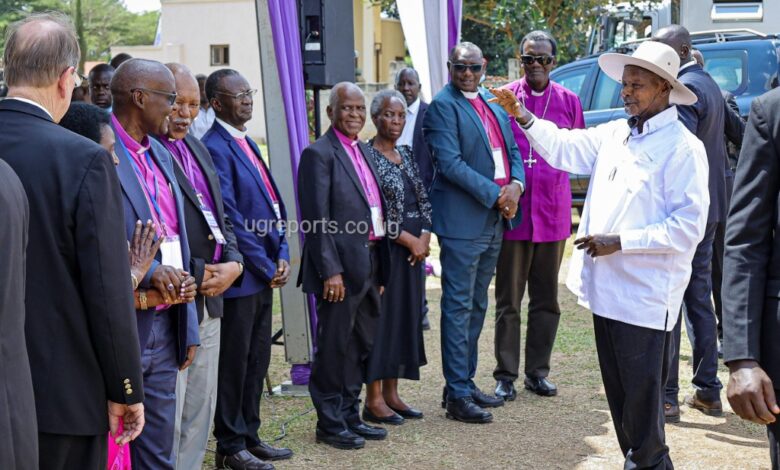
The celebrations concluded with a photo session involving President Museveni, bishops and their spouses, as well as people aged 95 and above who were saved during the East African Revival of the 1930s and 1940s.
Do you have an advertisement or article you want to publish? Mail us at theugreports@gmail.com or WhatsApp +256757022363.