Agago micro-scale irrigation project under fire as 39 model farmers report heavy losses
Instead of finding a thriving commercial farm, the team found a farmer struggling to recover his investment.


Agago: The Agago District Production Department is facing criticism after 39 beneficiaries of the government’s Micro-Scale Irrigation Programme reported suffering heavy financial losses instead of improving their livelihoods through commercial farming.
The affected farmers, drawn from Adilang, Kotomor, Agago Town Council, Lirapalwo, Lokole, Paimol, Lamiyo and Parabongo sub-counties, say the project has failed to deliver the expected benefits, leaving many burdened with debts and abandoned irrigation systems.
The Micro-Scale Irrigation Programme, implemented under the Government of Uganda Investment for Growth in Agriculture (UgIFT) initiative through the Ministry of Agriculture, Animal Industry and Fisheries (MAAIF), was launched in July 2020 to help smallholder farmers transition from subsistence to commercial agriculture.
Under the programme, government meets up to 75 percent of the cost of irrigation equipment, while farmers contribute the remaining 25 percent and receive agricultural extension support.
However, a recent inspection by Lt. Col. (Rtd.) Ambako Kibrai, the Senior Presidential Advisor on Mobilization attached to the RDC Secretariat, uncovered significant implementation challenges.

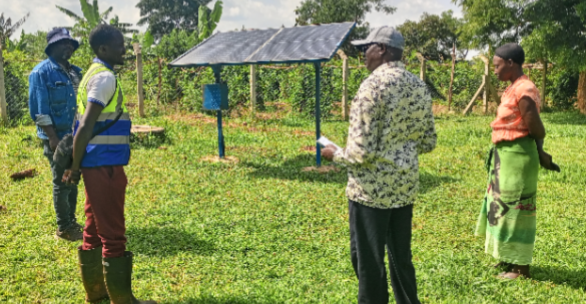
The inspection team visited the farm of Francis Ogwal, 45, of Lukee Village in Kotomor Sub-county, who had been presented by district officials as one of the programme’s model beneficiaries.
Instead of finding a thriving commercial farm, the team found a farmer struggling to recover his investment.
Ogwal said he contributed Shs2.2 million towards the project while government invested approximately Shs18.2 million, bringing the total investment to about Shs20.2 million.

To raise his contribution, Ogwal obtained an agribusiness loan from Centenary Bank and later sold his bull to keep up with loan repayments.
“I was supposed to complete the payments in installments every quarter, but the project was delayed. The irrigation system was only established in July 2024, and I started production in August. By the time the first loan repayment was due, I had not harvested anything,” Ogwal said.
He had expected to earn about Shs5 million from tomato production, but his two-acre irrigation site, located near a swamp, has been badly affected by flooding.
During the inspection, much of the garden was submerged, leaving only scattered plots of beans, bitter eggplants and okra. The beans had turned yellow due to prolonged waterlogging, with little hope of a meaningful harvest this season.
Ogwal blamed the losses on poor site selection.
“The engineer established the irrigation system in an area that floods. I can only use it effectively during the dry season,” he said.
He also revealed that he receives minimal technical support and has largely relied on indigenous farming knowledge and personal experience to manage the project.
Lt. Col. Kibrai expressed concern over what he described as inadequate technical support to beneficiaries.
“It is disappointing to see government projects failing because technical officers are not providing the necessary support to farmers,” Kibrai said.
Francis Oceng, the Agago District focal person for the Micro-Scale Irrigation Programme, acknowledged shortcomings in the project’s implementation.
He admitted that an engineer deployed by MAAIF failed to install the irrigation system on suitable high ground and pledged that extension workers would be deployed to support affected farmers.
Oceng also noted that Ogwal’s farm was performing relatively better than those of the other 38 beneficiaries, many of whom have reportedly abandoned the programme altogether.
He said the inspection had provided valuable lessons for district officials and promised improvements in technical supervision and farmer support.
Kibrai, who is currently monitoring government programmes across the Acholi sub-region, warned that poor technical implementation is undermining many government initiatives aimed at improving service delivery, fighting corruption and increasing household incomes. His assessment covers projects in the health, education, production and engineering sectors.
Do you have an advertisement or article you want to publish? Mail us at theugreports@gmail.com or WhatsApp +256757022363.