Zombo learners decry child labour, call for stronger child protection measures
“Some parents deliberately fail to provide school requirements, forcing children into labour. We need stronger interventions to support vulnerable children and secure their future,” he said.

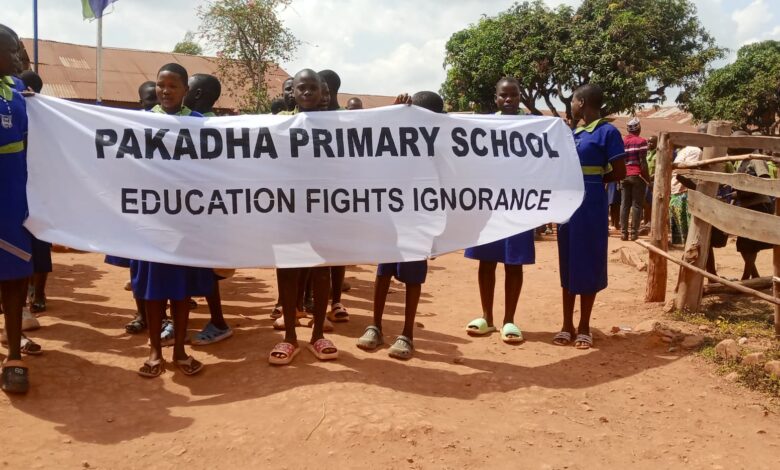

Zombo: Pupils from 12 primary schools in Abanga and Paidha sub-counties in Zombo District have raised concern over the persistent prevalence of child labour, particularly in the agricultural sector, and called on authorities and stakeholders to strengthen child protection interventions to keep children in school.
The learners voiced their concerns during the belated commemoration of the International Day Against Child Labour and the Day of the African Child, marked through drama performances, poems, riddles, and educative songs highlighting the dangers of child labour.
The activities were held on June 19, 2026, in various schools under the sustainability phase of the “Stop Child Labour” project.
This year’s World Day Against Child Labour was commemorated under the theme: “Red Card to Child Labour: Fair Play for Children, Decent Work for Adults.”
Speaking during the event, Atimango Angle, a pupil of Kaya Primary School in Paidha Sub-county, said many children are forced to miss classes because they lack scholastic materials and are instead engaged in strenuous agricultural work.

“Many children are not attending school because their parents cannot provide basic scholastic materials. Some are forced to spend most of their time working in gardens instead of studying. We appeal to leaders to protect our rights and ensure every child gets an education,” Atimango said.
Jonathan Odongo, a pupil at Jupumwocu Primary School, noted that excessive domestic and farm-related workloads continue to contribute to school dropouts.
“Many children are overworked at home and in the gardens. As a result, they become tired, lose interest in school, and eventually drop out. We need urgent action from all stakeholders to address this challenge,” Odongo said.

Kajik Parwoth Savior, also from Kaya Primary School, blamed the high dropout rates on some parents’ failure to provide basic necessities for their children.
“Some parents deliberately fail to provide school requirements, forcing children into labour. We need stronger interventions to support vulnerable children and secure their future,” he said.
Seasonal challenge in coffee-growing communities
Child labour remains one of the major child protection concerns in Zombo District, especially during the coffee harvesting season between August and January. During this period, many school-going children abandon classrooms to work on farms for meagre earnings.
Mr. Willy Ocaya, the project focal person for Paidha and Abanga sub-counties, urged local leaders to continue engaging communities on the importance of education and child protection.
“We have brought this celebration to the sub-counties to ensure sustainability. We are appealing to sub-county leaders to continue engaging parents, caregivers, stakeholders and district leaders so that our children remain in school,” Ocaya said.
Long-running anti-child labour initiative
The “Stop Child Labour” project, funded by the Education International and implemented by the Uganda National Teachers’ Union, has been running in Abanga and Paidha sub-counties since 2017.
The project seeks to reduce school dropout rates, combat teenage pregnancies, and prevent child marriages in rural communities. It is currently in its winding-up phase after nearly a decade of implementation.
According to the Ministry of Gender, Labour and Social Development, an estimated 6.2 million children, representing 40 percent of Ugandans aged between 5 and 17 years, are engaged in child labour. Many work in hazardous conditions due to poverty and limited access to education.
Globally, the International Labour Organization and UNICEF estimate that 160 million children are involved in child labour, with 79 million undertaking hazardous work.
In Uganda, child labour prevalence increased significantly from 14 percent in 2016/17 to 39.5 percent, equivalent to 6.2 million children, in 2021, excluding household chores.
Project implementers emphasized that sustained collaboration among local governments, schools, communities, civil society organizations, and development partners is critical to eliminating child labour, particularly within Uganda’s coffee-growing regions.
Meanwhile, Zombo District leaders remain optimistic that the proposed Education Ordinance, initiated in 2023, will strengthen the legal framework for child protection and school retention once enacted.
Do you have an advertisement or article you want to publish? Mail us at theugreports@gmail.com or WhatsApp +256757022363.