Mobile court boosts access to justice for refugees in Kiryandongo
He added that the mobile court has not only reduced the distance refugees have to travel to access justice, but has also helped them understand Uganda’s judicial system.

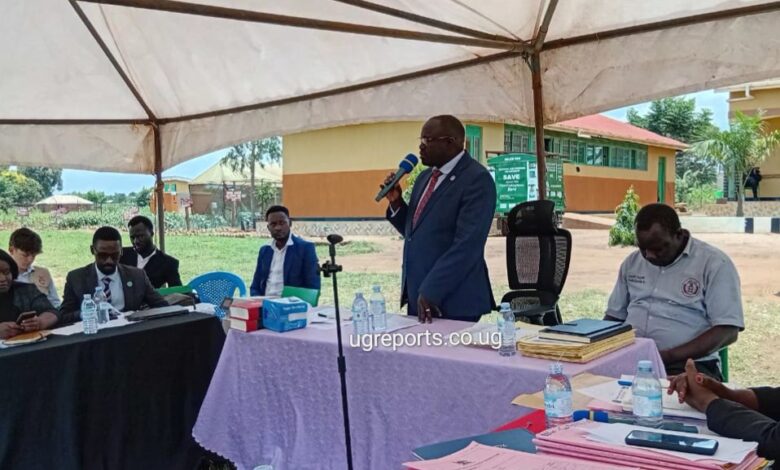

Kiryandongo: Access to justice for refugees in Kiryandongo has been boosted following a mobile court session held inside the Kiryandongo Refugee Settlement, bringing court services closer to thousands of refugees who face challenges accessing the district court.
The settlement currently hosts about 178,000 refugees from 15 countries, many of whom have struggled with the long distance to the district court and lack of transport to attend court proceedings.
Speaking during the mobile court session, the Camp Commandant for Kiryandongo Refugee Settlement, Amaroma Manza Vicente, said managing a settlement of such a large population requires teamwork among different stakeholders.
He commended the implementing and operating partners, including the United Nations High Commissioner for Refugees (UNHCR) and the Refugee Law Project, for supporting access to justice.
“Maintaining a settlement of this size is a big role, and teamwork by organizations has brought safe protection,” Amaroma said.

He added that the mobile court has not only reduced the distance refugees have to travel to access justice, but has also helped them understand Uganda’s judicial system.
“The mobile court has helped refugees understand how courts of law operate in Uganda, creating more confidence that Ugandan courts are transparent,” he said.
450 plea bargain cases handled

Owor Kennedy, a social lawyer and legal officer with the Refugee Law Project, said the Kiryandongo session was the fourth plea bargain session conducted in the settlement this year.
He said plea bargaining has played an important role in reducing congestion in prisons and easing pressure on the justice system.
According to Owor, about 450 plea bargain cases have been handled during the four mobile court sessions conducted this year, with a target of reaching 700 cases by the end of the year.
He attributed the progress to collaboration between the Office of the Director of Public Prosecutions, Kiryandongo Court, Refugee Law Project and the community.
Owor said plea bargaining also saves government resources, reduces the time spent in court and can result in lighter sentences for offenders who qualify.
Court faces language and staffing challenges
The Kiryandongo District Resident State Attorney, Counsel Roselyn Rukundo, , said the district presents unique challenges because of the many languages spoken by residents and refugees.
She said she is sometimes forced to act as an interpreter during court proceedings.
Rukundo encouraged residents to become more open to court procedures, explaining that plea bargaining gives accused persons an opportunity to negotiate sentences in accordance with the law.
The Chief Magistrate of Kiryandongo, His Worship Samson Abit, said the mobile court has helped reduce the backlog of cases.
He urged residents to embrace peaceful ways of resolving disputes and noted that refugees are treated like Ugandans before courts of law, although special consideration is given because many have experienced trauma before arriving in Uganda.
“Refugees are treated like Ugandans before court, but they are handled with special consideration because of the trauma they went through before reaching Uganda, which makes them vulnerable,” Abit said.
The Chief Magistrate also asked the DPP to establish offices in Kiryandongo District, citing understaffing at Kiryandongo Court as a major challenge affecting service delivery.
Leaders warn against selling land to refugees
The Vice Chairperson of Kiryandongo District, Hon. Salama Peace, urged stakeholders to stop selling land to refugees.
She reminded residents that refugees do not have the right to own land but can acquire land through leasing arrangements.
Meanwhile, Kiryandongo Deputy Resident District Commissioner Jonathan Akwetereho said Uganda has a long history of hosting refugees and cited the settlement of Kenyans in Panyadoli following the Mau Mau rebellion in the 1960s.
He described Uganda as a hub of peace and justice in the Great Lakes Region, saying peace is essential for development.
Akwetereho noted that nearly 60 percent of businesses in Bweyale Town are reportedly run by refugees, but warned about the rising number of juvenile offenders.
He also called for stronger efforts to fight corruption across all sectors, including among organisations implementing refugee-related programmes.
DPP cautions against forced plea bargains
The Director of Public Prosecutions, Lino Anguzu, said mobile courts have helped disadvantaged communities access justice at a reasonable cost.
He said the initiative has also provided a clearer picture of how justice is delivered in Kiryandongo and Uganda at large.
Anguzu encouraged eligible accused persons to embrace plea bargaining but cautioned inmates against accepting plea bargains simply because they want to leave prison.
“If you know you did not commit the offence, always ask for a full trial,” the DPP advised.
Anguzu also welcomed refugees in Uganda and urged them to settle, obey Ugandan laws, engage in agriculture even on small pieces of land and protect their families.
He asked Kiryandongo District authorities to provide land for the construction of a DPP office, saying that once land is secured, construction could begin as early as next year.
Do you have an advertisement or article you want to publish? Mail us at theugreports@gmail.com or WhatsApp +256757022363.