Bugisu Cultural Institution rejects Mulongo’s claims on sub-tribes, leadership
“Whereas Hon. Mulongo raises issues touching governance, we fundamentally disagree with the entire substance of his submission, which is tainted with bias,” Masiga stated.

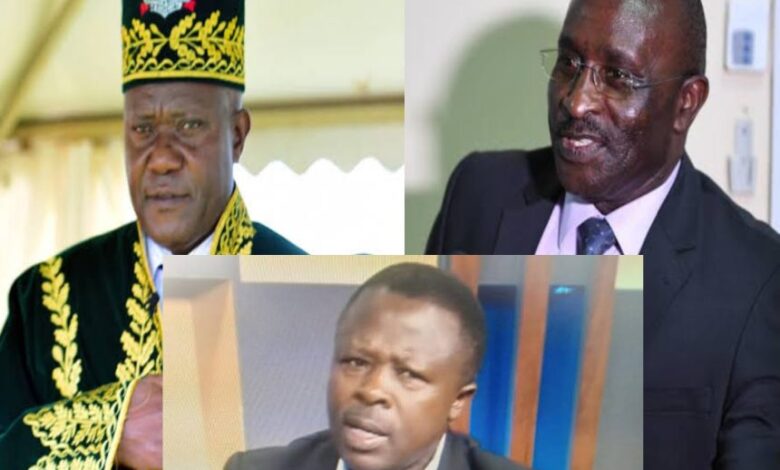

Mbale: The Bugisu Cultural Institution has strongly rejected remarks by former Ambassador to Somalia, Simon Mulongo, accusing him of attempting to divide the Bamasaba people through claims about sub-tribes and cultural leadership.
In a statement issued by the institution’s spokesperson, Steven Masiga, the leadership responded to concerns raised by Mulongo regarding two key issues: the tenure of the Umukuka and proposals to recast Inzu Ya Masaba as the supreme cultural authority in Bugisu.
Masiga acknowledged that Mulongo raises questions related to governance but said the institution fundamentally disagrees with his arguments, describing them as biased and legally unfounded.
“Whereas Hon. Mulongo raises issues touching governance, we fundamentally disagree with the entire substance of his submission, which is tainted with bias,” Masiga stated.
Masiga emphasized that cultural and traditional leadership in Uganda is anchored in the 1995 Constitution, noting that such institutions are creations of the law and can only be altered through legal processes.

“What is given by law can only be taken away by law,” he said, adding that law-making authority in Uganda rests with Parliament under Article 79 and, to a limited extent, local governments under the relevant statutes.
He challenged the legal basis of what he termed the “Inzu Ya Masaba constitution,” questioning the authority under which it was formulated.
The spokesperson argued that debates around identity and classification of the Bamasaba people were settled during the Constituent Assembly process that led to the 1995 Constitution.

He suggested that Mulongo, as a former Constituent Assembly delegate, should promote constitutionalism rather than advancing positions that contradict the existing legal framework.
Masiga further accused Mulongo of contributing to divisions within the region in the past and said current calls for unity appear inconsistent.
The Bugisu Cultural Institution also criticized Mulongo for allegedly calling on Bamasaba to rise against the Umukuka, warning that such statements risk undermining cultural unity and stability.
“We shall not allow attempts to incite our people against their cultural leader,” Masiga said.
He added that any attacks on the Umukuka indirectly challenge the legal framework under which the institution operates, and by extension, the government that recognizes it.
Masiga noted that some of the issues raised are currently before court and urged all parties to respect due process and avoid speculative statements that could interfere with ongoing proceedings.
“We encourage restraint and adherence to constitutional provisions, particularly as these matters are under judicial consideration,” he said.
The institution reaffirmed its commitment to defending the cultural leadership of the Umukuka and preserving unity among the Bamasaba.
Masiga concluded by calling on Mulongo to retract his statements and instead support efforts aimed at strengthening cultural cohesion and lawful governance structures.
Do you have an advertisement or article you want to publish? Mail us at theugreports@gmail.com or WhatsApp +256757022363.