Over 300 Masindi Prison inmates apply for plea bargains as judiciary intensifies case backlog clearance
"This is one of the biggest prison camps focusing on capital cases. By the close of business on the first day alone, the judges had already handled 83 cases," Bwambale said.

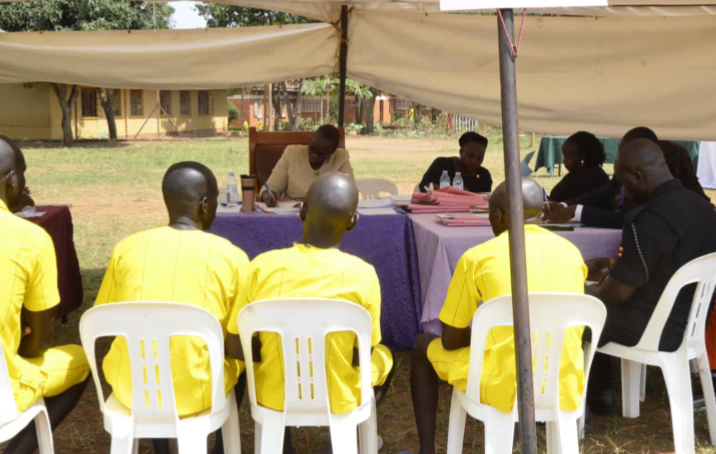

Masindi: More than 300 inmates at Masindi Government Prison have applied for plea bargains during a three-day special prison camp aimed at reducing the growing backlog of capital criminal cases.
The exercise, which started on Wednesday, July 8, 2026, and ends on Friday, July 10, 2026, is one of the Judiciary’s largest plea bargain camps focusing on capital offences in the country.
According to court officials, the camp is handling 336 pending criminal cases, with 100 aggravated defilement cases, 54 aggravated robbery cases, 45 murder cases, 36 rape cases, and nine aggravated trafficking cases among those being considered.
The sessions are being presided over by Justice Jane Okwo Kajuga, the Judiciary’s plea bargain focal judge, alongside Justice Professor Andrew Khaukha, the Alternative Dispute Resolution (ADR) focal judge and Executive Director of the Judiciary Training Institute.
Other judicial officers participating in the exercise include Justice Mary Babirye, Resident Judge of the Masindi High Court, Justice Vincent Opyeno, Resident Judge of the Hoima High Court, and Justice Johnson Karemani, Resident Judge of the Kiboga High Court. Masindi Chief Magistrate Gumtwero Olal is also facilitating the committal of capital cases that had not yet been forwarded to the High Court.

Speaking during the exercise, His Worship Daniel Bwambale, Senior Principal Magistrate for Alternative Dispute Resolution, said the Masindi prison camp is among the biggest initiatives dedicated to capital offences.
“This is one of the biggest prison camps focusing on capital cases. By the close of business on the first day alone, the judges had already handled 83 cases,” Bwambale said.
The Registrar of the Masindi High Court, Juliet Nakitende, revealed that the court is currently handling 336 pending criminal cases, urging residents of Masindi and the wider Bunyoro sub-region to embrace Alternative Dispute Resolution mechanisms.

Her Worship Justine Atukwasa, Registrar of the Alternative Dispute Resolution Registry, said plea bargaining has become an important tool in delivering timely justice.
“Plea bargaining has become a crucial mechanism in the administration of justice. In the last financial year alone, more than 10,000 cases were completed through this process nationwide,” Atukwasa said.
Mediators warned against extortion
Later in the day, Atukwasa met court-annexed mediators from Masindi and Hoima at the Masindi High Court to assess their capacity and discuss strategies for strengthening mediation services in the region.
She emphasized that mediation offers quicker, less costly and relationship-preserving solutions to disputes.
“As mediators, you are supposed to be simple and easy. We need to appreciate that mediation is advantageous because it is fast, less costly and restores relationships. It contributes to peaceful communities and creates a win-win situation because disputes are resolved immediately and the parties accept the outcomes,” Atukwasa said.
She warned mediators against demanding money from litigants, saying such conduct amounts to misconduct.
“Mediators should do everything following the law. Desist from charging the parties money. The parties can only appreciate you when the matter is resolved, if they wish. Charging parties is a disciplinary issue that could lead to cancellation of your accreditation,” she warned.
Atukwasa also directed that every court registry should maintain proper records of all cases resolved through mediation.
Former Bishop of Masindi-Kitara Diocese, Rt. Rev. George William Kasangaki, appealed to the Judiciary to strengthen the mediation system by providing mediators with adequate training, the ADR policy and mediation rules.
Meanwhile, the regional chairperson of court-annexed mediators, Rev. John Kitalibara, said mediation is increasingly being embraced as the quickest way of resolving disputes, especially land conflicts that continue to divide families and communities.
“Mediation with a good judicial officer is work done, but mediation with a frustrating judicial officer is no work done,” Kitalibara said.
He called for continuous sensitization and training of judicial officers and lawyers to promote wider acceptance of mediation as an effective dispute resolution mechanism.
Do you have an advertisement or article you want to publish? Mail us at theugreports@gmail.com or WhatsApp +256757022363.