Stakeholders call for conservation of Murchison Falls–Albert Delta Ramsar Site
He expressed optimism that reviving such structures could strengthen conservation efforts.

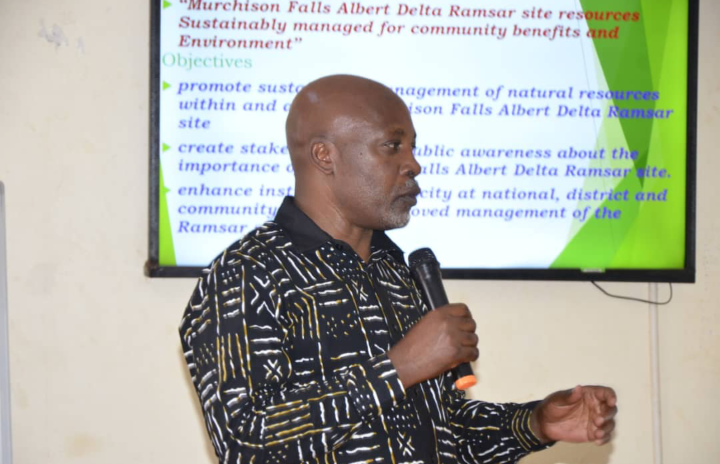

Masindi: Residents of five districts in the Albertine region have been urged to safeguard wetlands designated as Ramsar sites to ensure their sustainability for future generations.
The call targets communities in Masindi, Buliisa, Kiryandongo, Nwoya, and Pakwach, where key ecosystems form part of the Murchison Falls–Albert Delta Ramsar Site, an internationally recognized wetland system under the Ramsar Convention that includes Murchison Falls National Park and the Albert Nile.
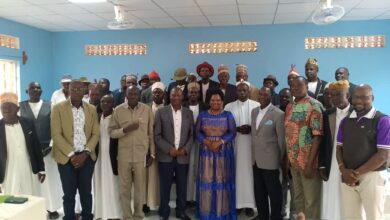
The appeal follows a stakeholders’ meeting held on Wednesday April 1,2026 at the Masindi District Health Office boardroom, organized by Nature Uganda, to review and update the wetland management plan.
Speaking to the media after the engagement, Achilles Byaruhanga, the Executive Director of Nature Uganda said the meeting aimed at identifying effective strategies to conserve the Ramsar site.
He challenged communities to actively participate in protecting the wetland, noting that it provides essential resources such as water, fish, and sand, which support livelihoods.

“Let us engage the community in conserving these natural resources because they play a crucial role in our daily lives, including fishing, collecting water, and firewood from forests,” he said.
Byaruhanga added that stakeholders resolved to intensify community sensitization on the importance of conserving the Ramsar site for both future generations and national revenue mobilization.
Wilson Kagoro, a Conservation Officer with the Uganda Wildlife Authority (UWA) attached to Murchison Falls National Park, said strict measures are in place to curb illegal activities.

“We do not allow illegal activities such as hunting and fishing in protected areas to prevent degradation of the Ramsar site,” he explained.
He advised residents to desist from illegal activities within protected areas to safeguard the ecosystem.
Lilian Kempango, Biodiversity Engineer for Forests and Wetlands at TotalEnergies Uganda, said the company is committed to mitigating the negative impacts of climate change and conserving natural resources such as Budongo Forest, Bugoma Forest, and the Albert Nile.
She revealed that the company has initiated a biodiversity programme aimed at protecting ecosystems even after oil and gas activities in the region.
Daniel Businge, the Regional Wetland Coordinator for Western Uganda at the Ministry of Water and Environment, highlighted trends in wetland coverage in Uganda.
He noted that wetland coverage declined from 37,559.4 square kilometres (15.6% of Uganda’s surface area) in 1994 to 31,412.7 square kilometres (13%) in 2015. However, by 2021, coverage had increased to 33,762.6 square kilometres (13.9%).
Businge attributed the earlier decline to encroachment for agriculture, settlements, and industrial development. The recent increase, he said, is due to intensified restoration efforts, rising lake water levels, and increased political support for conservation.
He added that intact wetlands currently cover 22,457.4 square kilometres (9.3%), while degraded wetlands account for 11,305.1 square kilometres (4.7%).
According to Businge, the Central region has the highest proportion of intact wetlands, while the Eastern region accounts for the largest share (41%) of degraded wetlands. The Western region has the least coverage of both intact and degraded wetlands.
Samuel Magambo, Assistant Chief Administrative Officer of Buliisa District, noted that traditional cultural and clan systems historically played a key role in natural resource management.
He expressed optimism that reviving such structures could strengthen conservation efforts.
Magambo also highlighted the economic benefits of Murchison Falls National Park, noting that Buliisa District receives about Shs1 billion annually through the UWA revenue-sharing scheme.
“Buliisa receives about Shs1 billion every financial year through the UWA revenue-sharing scheme. This has enabled the district to set up structures such as Bugana Health Centre III, Kirama Vocational Institute, and several sub-county headquarters, as well as empower community groups to improve livelihoods,” he said.
He said the district will continue sensitizing communities on the importance of conserving Ramsar sites and other natural resources.
Yusuf Akubonabona, the Deputy Chief Administrative Officer of Nwoya District, said the engagement comes at a critical time when the Ramsar site is increasingly being encroached upon due to rapid population growth.
“This engagement has come at the right time because the Ramsar site, along with other natural resources such as forests and rivers, is being encroached on and degraded,” he said.
He warned that failure to conserve the site could lead to loss of environmental and economic benefits derived from it.
Do you have an advertisement or article you want to publish? Mail us at theugreports@gmail.com or WhatsApp +256757022363.