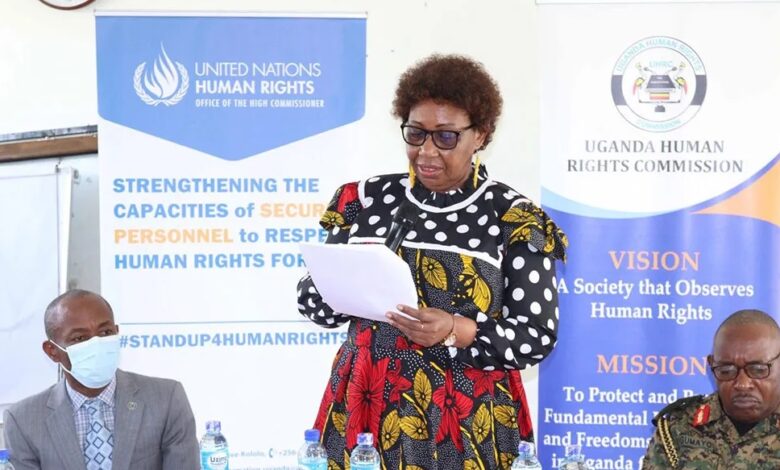

The controversial Court of Appeal judge, Justice Musa Ssekaana, and the Uganda Human Rights Commission (UHRC) chairperson, Mariam Wangadya, have recently become household names on online blogs known for negative publicity against prominent Ugandans.
Sources within the corridors of power have revealed the likely reason behind the sudden media attention, particularly targeting Wangadya.
It is reported that there has been intense lobbying by various legal professionals seeking appointment to the position of Deputy Chief Justice, following the elevation of Flavian Zeija to Chief Justice.
The Judicial Service Commission, through its Permanent Secretary Rose Nassali Lukwago, announced that the process of identifying a suitable candidate for the position had commenced.
Sources indicate that lobbying is in high gear, with senior judicial officers and private lawyers competing for the lucrative post. Although Justice Ssekaana and Wangadya have not publicly declared interest, insiders say they are among the top potential contenders.

Highly placed sources at State House revealed that Muslim leaders, both from the Uganda Muslim Supreme Council and the Kibuli-based Supreme Mufti leadership, are lobbying for the position to be awarded to a Muslim lawyer.
However, Yoweri Museveni is reportedly focused on appointing a candidate with integrity, amid concerns that many career judicial officers have been mentioned in corruption intelligence reports.
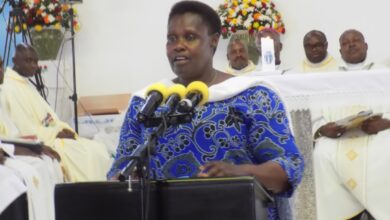
Wangadya, a former Deputy Inspector General of Government and current head of the country’s human rights watchdog, is seen as having an upper hand, especially given the President’s desire to clean up the judiciary.
This, sources claim, has triggered a series of attempts to discredit her, including a recent purported whistleblower report that has been circulated for weeks by an online media outlet. The report is said to have been filed with the Inspector General of Government, the State House Anti-Corruption Unit, and the Criminal Investigations Directorate, requesting investigations into her conduct.
Sources say that beyond her being a Muslim lawyer, Wangadya is highly hardworking. She has significantly improved the rate at which decisions are delivered by the UHRC Tribunal, reportedly issuing an average of 20 rulings in a two-day sitting. This contrasts with the Court of Appeal, where justices may deliver a similar number over a four-month session.
There are also indications that the President may prefer appointing a female Deputy Chief Justice this time, drawing comparisons with past female office holders such as Alice Mpagi-Bahigeine and Constance Byamugisha. During their tenures, Uganda’s appellate jurisprudence was considered stronger and attracted international recognition.
Analysts argue that male Deputy Chief Justices have, over time, widened the gap between the Bar and the Bench (lawyers and judges), leading to tensions within the legal fraternity. Some critics attribute this to rigid leadership styles, suggesting that gender balance at the top could improve harmony within the judiciary.
It is also alleged that some individuals behind the smear campaign are seeking revenge against Wangadya. She is remembered for exposing alleged corruption syndicates in Parliament during the budget-making process, which led to the arrest of several legislators, including Cissy Namujju and Paul Akampa.
Wangadya later testified against the accused, explaining how the operation had been coordinated. However, the subsequent withdrawal of charges and release of the suspects cast the government in a negative light regarding its anti-corruption efforts.
Since his time heading the Civil Registry at the High Court, Justice Ssekaana has been viewed as a rising figure within the judiciary. Many, particularly within the Muslim community, had anticipated that he could eventually become Uganda’s first Muslim Chief Justice.
However, his rise has not been without controversy. Critics have filed numerous complaints against him, and negative reports have allegedly been submitted to the appointing authority and the Judicial Service Commission.
Sources within the commission led by Douglas Singiza indicate that some of these complaints are scheduled for expedited hearings before the conclusion of the Deputy Chief Justice selection process.
Additionally, divisions within the Muslim leadership have emerged. Some Kibuli-based leaders are reportedly dissatisfied with Ssekaana after he declined to recuse himself from a case involving Juma Zukuli, citing concerns of bias.
The titular Muslim leader, Kassim Nakibinge Kakungulu, who had supported Ssekaana’s appointment as a High Court judge in 2018, is said to be unhappy with some of his rulings, including decisions that led to the imprisonment of Khalifa Lutaaya and Hassan Kinene on contempt of court charges.
Ssekaana has also faced criticism for allegedly being intolerant of social media criticism and for engaging in personal exchanges with lawyers during court proceedings.
President Museveni has, in several instances, appointed Deputy Chief Justices from among Supreme Court justices. Other potential candidates include Geoffrey Kiryabwire, Barishaki Cheborion, and Eldad Mwangusya Egonda-Ntende of the Court of Appeal.
The Deputy Chief Justice heads the Court of Appeal, which also serves as the Constitutional Court. To qualify for the position, one must hold a Bachelor of Laws degree and be a judge of the Court of Appeal, Supreme Court, or High Court. Advocates with at least 15 years of experience are also eligible.
According to sources, the President is keen on appointing the Deputy Chief Justice before the next swearing-in ceremony to avoid any leadership vacuum in government. This aligns with his broader directive to ensure continuity, including the timely election of local village leadership ahead of May 2026.



This is one of the best explanations I’ve read on this topic.