Charcoal trade devastates forests in Kotido
Kampala and Mbale city councils could regulate charcoal stalls, impose penalties for illegal sales and support clean-fuel kiosks.

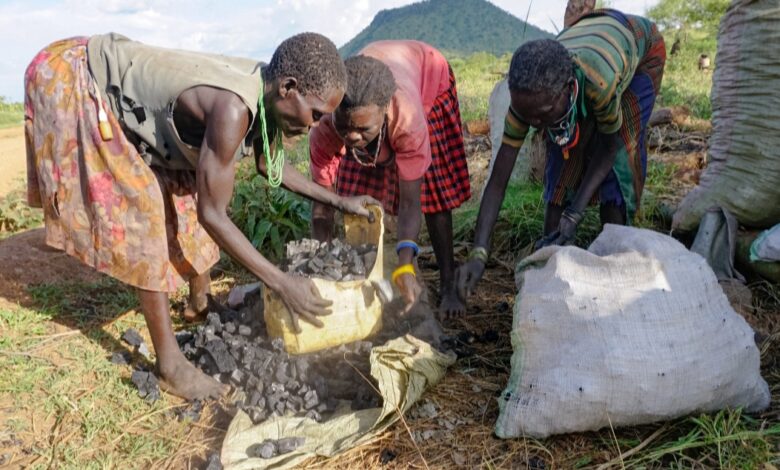

Kotido: Along most of the roads in Kotido district, stacks of charcoal sacks line awaiting to be sold to any possible interested buyer while other sacks are awaiting transit outside the district.
43-old Mary Nangiro, a mother of eleven, arranges her sacks as passing motorists hail vendors in Lolelia Sub county “I began burning charcoal in 2019 when drought wiped out my sorghum, “It’s the only way I can feed my family now.” she says
What started as a coping strategy has grown into an industry that fells some 4,000 trees every month across Kotido District more than 40,000 annually according to local forestry figures. In a region where annual rainfall hovers around 600 millimetres and sandy soils drain rapidly, the loss of shea, acacia and tamarind worsens water stress, undermines crop yields and threatens livelihoods.
Karamoja’s charcoal trade traces back to 2009, when traders from Mbale introduced the first earthen kilns. The process remains unchanged: fell trees, stack logs in a pit, cover with earth or soil, ignite and collect charcoal after three days of smoldering. At the kiln site, operators earn roughly UGX 15,000 per sack; vendors like Nangiro then sell each sack for UGX 20,000.
After middlemen transport and mark up the product, urban consumers in Kampala pay as much as UGX 110,000, creating a supply chain that siphons value from Karamoja’s fragile forest.

“Locals barely break even,” explains Christine Lokiru, Kotido’s natural resources officer. “Most of our charcoal goes to external markets. Middlemen in Mbale and Kampala capture the biggest share.” Lokiru office has mapped deforestation hotspots in Rengen, Maaru, Kolasarich and chamkok, which together account for nearly 90 percent of tree losses.
Joel Olal, Kotido’s forestry officer, warns that indiscriminate tree felling erodes the land’s ability to retain scarce rainfall. “When we lose trees, our soils become even more porous,” adding that every felled tree chips away at our water table. We’re already seeing seasonal watercourses disappear—threatening both farming and livestock.” Olal Okello is spearheading a district nursery programme to supply seedlings to farmers practicing agroforestry.
Kotido Health Department data underlines the public-health toll. Last year, nearly 30 percent of children under five suffered acute respiratory infections cases often linked to household smoke from charcoal stoves. Meanwhile, Uganda’s National Forestry Authority reports a nationwide forest loss of 122,000 hectares annually, with Kotido accounting for 29 hectares in 2020 alone releasing nearly 20,000 tonnes of CO₂.
In May 2023, President Yoweri Museveni issued Executive Order No. 3 banning commercial charcoal production in all Karamoja districts. Since then, joint security forces have impounded more than 8,400 bags of charcoal, which are handed over to the National Forestry Authority for destruction. Checkpoints on the Kotido–Moroto and Kotido–Kaabong highways intercept laden trucks, while mobile patrols monitor feeder roads.
Yet enforcement falters on the ground. Kotido’s police service lacks a dedicated environmental unit, Corruption further undermines operations: “A little kint kidogo greases the way, “referring to petty bribes that free illicit haulers” says Nangiro.
Kotido District Council drafted its own ordinance last year to outlaw commercial charcoal burning, but the measure remains stalled pending clearance from the attorney general’s office in Kampala. “Our people depend on charcoal income,” explains Council Speaker Lodiyo Emmanuel. “Pushing a ban without viable alternatives risks social unrest.”
Resident District Commissioner Charles Ichogor underscores the stakes: “Cutting desert date and tamarind trees for charcoal strips us of crucial food, medicine and cultural heritage,” he warns. Ichogor says he is working with security forces and development partners to strengthen “zero-tolerance” checkpoints and fast-track the council ordinance.
prohibition alone will not stem the crisis. “Without affordable, cleaner fuel options, bans push charcoal production underground.
Ugandan households in informal urban settlements rely heavily on charcoal because biogas infrastructures remain underdeveloped.
There is need for subsidies, micro-credit and social-marketing campaigns to drive demand for alternatives.
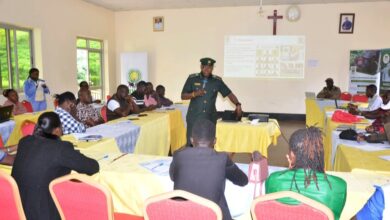
Meanwhile, grassroots interventions in Rengen and Nakapelimoru sub-counties offer a glimmer of hope. NGOs are holding briquette-making trainings engaging participants from both sub-counties in producing eco-friendly briquettes from sawdust, charcoal dust and other agricultural residues.
“This initiative is a shining example of community-led sustainable development,” says Joel Olal Okello. “By utilizing waste materials for fuel, we protect our forests while empowering our people economically.”
Resident District Commissioner Charles Ichogor endorses the pilots: “These models in Nakapelimoru and Rengen show how grassroots innovation can break our charcoal dependency and restore critical tree species.”
Kampala and Mbale city councils could regulate charcoal stalls, impose penalties for illegal sales and support clean-fuel kiosks.
A multifaceted strategy is essential. Recommendations include; enacting the Kotido charcoal-ban ordinance and allocating district funds for environmental patrols, expanding agroforestry and biomass-briquette programmes through joint government and donor funding and integrating solar and efficient-stove initiatives with micro-credit and social marketing.
Others are launching urban consumer campaigns to promote cleaner fuels and strengthening climate-information networks to deliver consistent, science-grounded messaging.
For now, Kotido’s woodlands continue to recede, with each tree felled eroding both ecological resilience and cultural heritage. Nangiro, the charcoal vendor, remains caught between subsistence and sustainability.
“I know these trees are precious,” she says, lifting a sack onto her head. “But when your children cry for food, you must choose.”
As Kotido approaches a critical juncture, its path forward will test the balance between survival and conservation a dilemma playing out across the drylands of sub-Saharan Africa.
Whether community innovation, policy enforcement and market reforms can converge in time will determine if this corner of Karamoja becomes a cautionary tale or a beacon of green resilience.
Do you have an advertisement or article you want to publish? Mail us at theugreports@gmail.com or WhatsApp +256757022363.