Vaccines shielding Kiryandongo Poultry Farmers Against Climate Change
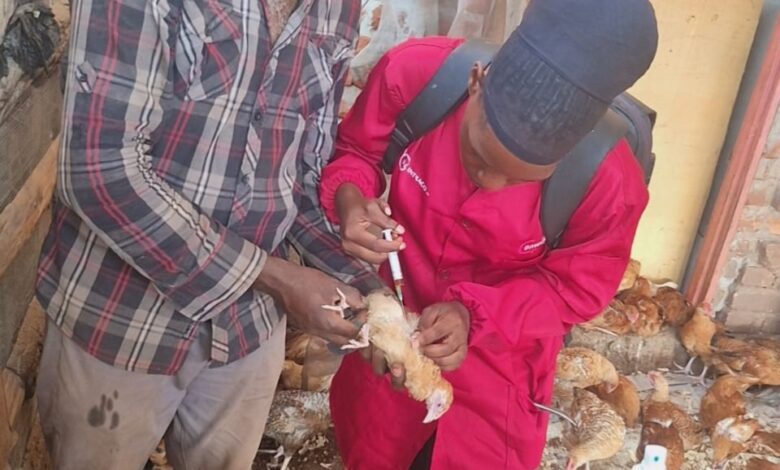
Vaccination prepares a bird's immune system to fight diseases before infection occurs.


Kiryandongo: Climate change is no longer just about changing weather patterns for crop productions. It is also drastically affecting animal health among livestock farmers across Uganda.
In Kiryandongo district, long periods of extreme heat and cold are already stressing poultry to mortality by reducing their immunity and making them more vulnerable to disease. Heavy rains and flooding is also creating damp conditions that allow disease-causing organisms to spread more easily among flocks.
When birds exposed to such conditions become weakened by heat or poor environmental conditions, a single disease outbreak can spread quickly through the entire flock, a perfect stage for that one outbreak to erase months of hard work and financial investment.
By 2021, the above situation was commonplace among smallholder poultry farmers in Kiryandongo district as outbreaks of diseases such as Newcastle disease, Gumboro disease, fowl pox, and infectious bronchitis swept across the mid-northern region of Uganda.
That year, many farmers lost significant amounts of money in investment as they either vaccinated too late, skipped vaccinations altogether, or did not follow the correct vaccination schedule. Within days, farmers were left with losses in millions as thousands of birds perished.

Climate Smart Investors
Although veterinary vaccines cannot stop climate change, they protect the farmers’ profits by helping birds develop protection against preventable diseases. Vaccination with quality drugs prepares the birds to better resist infections such as Newcastle disease, Gumboro disease, fowl pox, and lethal infectious bronchitis.
In Bweyale Town Council, poultry farmers are blending vaccination with proper feeding, clean water, good ventilation, sanitation, and biosecurity to greatly reduce losses caused by disease outbreaks. They have been trained that healthy birds are more productive and more profitable to every farmer.

Inside a small poultry house this morning, four women are vaccinating up to 300 chicks. They measure the dose, mix the vaccine in clean water, and administer them as eye drops to each of the pecking chicks. Entertaining and happy bird calls fill the room in rhythmic repeats of patterns. No one is supervising the three ladies dressed in branded overalls and gumboots. Masks firm to their nostrils.
Two years ago, these women could not attempt to vaccinate any bird, at least by themselves. Today, they are their own paraprofessional veterinarians trained by Bweyale Vet Center, a commercial agribusiness agent partnering with Climate Smart Jobs to transform agriculture in the region.
Their training lasted several months before they gained the confidence to self-treat their birds, alongside 10 other smallholder poultry farmer groups in the district.
Beyond vaccination, the farmers were also coached on disease prevention, farm management practices, and group marketing of their poultry. Disease prevention is one of the smartest climate adaptation strategies for poultry farmers in the region.
Vaccination Schedule
Poultry farmers in Kiryandongo district are not completely powerless against Climate Change. They have learned to carry out timely vaccination to protect their birds from preventable diseases, improves survival, increases eggs and meat production.
Healthy birds mean stronger businesses and strengthened household incomes. Bweyale Vet Centre is supporting poultry farmers to achieve just that with feeds and drugs on credits as they provide them with timely extension services.
Jeska Orodriyo, a beneficiary under Bweyale Vet Center is looking after 400 Kroiler Chickens. She wakes up at 6:30am to vaccinate them against Newcastle disease. More of her birds now survive in her care compared to two years ago. Her eggs and meat delivery to the market has also improved over time, just so does her income.
“Over dose kills the birds immediately. Under dose gives them no protection. This is why farmers spending huge money on drugs still lose the birds and blame the government for poor quality drugs.” Jeska explained while looking at the vaccine bottles piled in a saucer bowl for safe disposal.
A mature Kroiler bird sells between 25,000 – 30,000 Uganda shillings at various seasons of the year while a tray of eggs goes for 12,000 Uganda shillings. And when 100 such birds die, a farmer loses 2.5 million shillings, enough to expand the business and foot school fees or buy food for the family for a month. Eggs and meat would also disappear from the family plate and the local economy. Money leaves in exorbitant importation of poultry products. During such a time, cases of children with protein deficiency and stunting rise in health facilities due to malnutrition.
This is the main reason why Bweyale Vet Center emphasizes adherence to vaccination schedules among farmers. The goal is so they don’t just use medicine, but use it properly.
Vaccination prepares a bird’s immune system to fight diseases before infection occurs.
According to Jeska, healthy birds grow faster, lay more eggs, convert feed more efficiently, and require fewer treatments for preventable diseases compared to those unvaccinated counterparts.
To be more successful, a farmer should keep a vaccination calendar, purchase vaccines from trusted suppliers, store vaccines under the recommended conditions, vaccinate healthy birds at the correct age, and maintain good hygiene in poultry houses.
The others include providing clean water, quality feed, and proper ventilation for the birds. If disease signs appear, consult a qualified veterinary professional immediately. Never wait until many birds are sick before taking action.
Microbial Resistance
Vaccination is much cheaper than treating disease outbreaks or replacing birds after heavy losses among smallholder farmers in Kiryandongo district.
To achieve high success rates, vaccines must be stored correctly, administered at the recommended age, and handled according to veterinary guidance to prevent birds developing resistance to the diseases.
Fred Tulizele, another poultry farmer in Bweyale Town Council joined the business in 2021 with some 200 birds. He lost 130 of them in a single disease outbreak in 2022 in a space of three days. Devastated, he rushed to hire a man to vaccinate the remaining birds and paid him 60,000 Uganda shillings.
His experience changed after joining a Farmer group under Bweyale Vet Center in 2023. He now vaccinates his birds himself. According to him, the key is in respecting the vaccination schedules, correct dosing, and disease prevention. Through his group, he received a cool vaccine box from Bweyale Vet Center in which he packs his vaccine with iceblocks to preserve its integrity.
On every 7th and 21st day of a chick’s growth, Bweyale Vet Center digitally sends him a vaccination reminder. When needed, he is supervised by an extension staff who monitors their performances. He is now a proud poultry farmer with 450 layer birds.
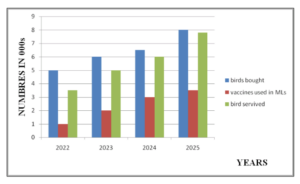
Table showing Vaccine Usage among poultry farmers in Kiryandongo district.
| Year | Birds Bought | Mortality | Vaccines / Mls |
| 2022 | 5,000 | 1,500 | 300 |
| 2023 | 6,000 | 1,000 | 400 |
| 2024 | 6,500 | 500 | 550 |
| 2025 | 8,000 | 200 | 800 |
Cashflow
Fred collects and sells 18 trays of eggs every week, earning him an average of 216,000 Uganda shillings as his children enjoy nutritious eggs and meat at will four times a week compared to the previous once every Sunday when there was money to spare.
Solomy Nakazi, the proprietor of Solomy Venture began with keeping broilers which she struggled to grow and sustain. Her birds grew slowly as traders underpaid her for their sickly appearances. After training with Bweyale Vet Center, she improved her management practices, vaccination routine and income as well.
“Litter management, deworming schedules, and persistent disease outbreaks used to wipe my profits clean. I also never knew how to do professional marketing of the birds. I now trade with buyers in Kampala, thanks to our commercial agent.” she happily exclaimed with smiles on her face.
Nakazi’s farm is home to 600 broiler birds. She takes to the bank 1.8 million every 6 weeks.
Bazilio Okongo leads a youth group having 6 members. They started with 100 birds and hardly no capital back in 2022. Bweyale Vet Center came handy with professional hands-on training wrapped in credits for feeds and veterinary drugs as well as regular extension services. They now own 500 layers supplying eggs to three primary schools and two restaurants in Bweyale Township. The group’s monthly turnover is about 1.2 million Uganda shillings, a perfect demonstration that farm incomes become more stable throughout the year with sustained vaccination.
Over the two years of engaging farmers in Bweyale Township, malnutrition cases have dramatically declined among farmer households. The Uganda Demographic and Health Survey (2022) shows that 26% of children under five suffered from chronic malnutrition or stunting at the time.
As poultry takes practical climate solutions to people’s doorstep, poultry vaccination is helping farmers across Uganda keep their birds healthy, reduce losses, and increase their profits.
This story was produced with support from Climate Smart Jobs in partnership with InfoNile
Do you have an advertisement or article you want to publish? Mail us at theugreports@gmail.com or WhatsApp +256757022363.