Small Birds, Big Impact: Poultry and Climate Resilience in Kiryandongo Refugees Settlement
The task now is “to inspire those raising local chicken varieties to opt for fast maturing and climate resilient breeds for them to improve their livelihoods,” Wabwire stated.

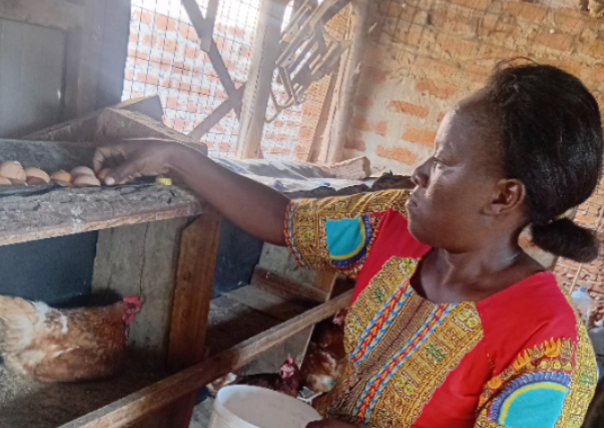

Kiryandongo: On a small plot in Kiryandongo Refugee Settlement, Zainab Al Jack checks feeders for her layer birds. Five years ago, mature poultry meant dinner for the family. Today, it means school fees, rent, and hope.
Zainab kept a few chickens back in South Sudan just for home consumption before conflict pushed her out of her homeland into Kiryandongo Refugee Settlement in Uganda. She is a refugee of many faces since she joined Khafa Poultry Farm, owned and operated by refugees.
It is from the group that she learned how to manage her poultry project. The district is hosting 166,907 registered refugees and asylum seekers, all struggling to find decent livelihoods alongside a population of 364,872 people.
Sudanese refugees make up 47.5% of the settlement’s population, with 74% of the settlement’s total population being women and children, according to the Sudan Regional Crisis Development Action Platform and the Office of the Prime Minister of Uganda.
Uganda’s refugee policy, hailed as the best in the world, grants refugees living in designated settlements access to small plots of land measuring about 15Meters by 45Meters for food crop production. Many families struggle to provide enough for their households all year round. Poultry provides the much needed diversification for such households to generate cash for other basic necessities.

The refugee group works with Bweyale Vet Center, a commercial agent under a transformative agribusiness initiative of the Climate Smart Jobs, an initiative of Palladium UK working to transform agribusiness in Northern Uganda.
The goal of the partnership is to support the farmer groups access quality feeds, veterinary services and markets for their products.
Labour for Layer Birds
Under the Point of Lay layers, farmer groups receive layer birds under an understanding in which they share proceeds from the eggs they collect and sell in exchange for labour for caring for the birds. They keep birds belonging to a commercial agent while earning income from its products. Effective veterinary and extension services flow through the value chain to minimize diseases, losses and mortality among farmers.
Layer birds are supplied alongside quality feed concentrates and vitamins as regular extension visits combat negative farmers’ mindset. Poultry products, eggs and meat, then provide critical sources of animal protein for the farmers’ families.
Sarah Babirye, an extension worker attached to Bweyale Vet Centre says up to eight Farmer Group Enterprises involved in the Poultry value chain have ratified their Memorandum of understanding under the Model.
The groups are Israel Poultry and Business composed of five members – 4 males and 1 female; Khafa Poultry Farm with 2 men and 3 women; Moga Poultry and Business Company (all male); Kandakat Poultry Farm (all female) as well as the KSNS Poultry and Business Bweyale with 3 women and 2 men. All groups have members from the Kiryandongo refugee settlement.
The Refugee group, Khafa Poultry Farm, is currently managing more than 4,000 layer birds across 6 groups located within the settlement. Cumulatively, they collect more than 100 trays of eggs daily. If each tray sells at 10,000 shillings, the group earns a decent One Million shillings daily, a percentage of which flow back into their pockets.
Bweyale Vet Center, the commercial agent established broadening centers for raising the layers from day old, before they are supplied to the farmers on loan or credit sales. Offlayers are also sold in the local market which previously depended on imported poultry products.
Progress Dresses in Overalls
Climate scientists say poultry generally present with lower greenhouse gas emissions per kilogram of meat or eggs produced compared to other livestock systems. This is particularly true because chickens convert feed into protein efficiently and produce less methane than ruminants such as cattle and sheep. However, poultry is not a complete solution on its own and still has environmental impacts that require careful management.
For refugees like Zainab, manure generated from the waste coming out of the Poultry farm is excellent feed for her small plot to regenerate its fertility. Integrated with other climate Smart practices like water conservation techniques, the Point of lay Layers is transforming Kiryandongo Refugee Settlement one household at a time.
Dorcus Ayebale is a farmer located just at the edge of the refugee settlement in the host community. She is attached to KSNS Bweyale Poultry Farm. “Each one of us now views chicken in terms of cash for the household. Knowledge is indeed power to the industrious”
Ayebale says she has gained enough confidence to raise more than 500 birds as an individual, capital allowing. Her testimony is confirmation that progress dresses as work in intimidating overalls.
Tonny Wabwire, the Kiryandongo District Veterinary Officer says the project has illuminated all the dark corners of the district by attracting up to 25,000 households into the value chain.
| Poultry Practices for Maximizing Climate Benefits |
| ● Improve feed quality to increase efficiency.
● Use renewable energy in poultry houses where feasible. ● Manage manure through composting or biogas production. ● Reduce food and feed waste. ● Adopt climate-smart housing with good ventilation and energy-efficient equipment. ● Practice strong biosecurity to reduce disease losses and unnecessary resource use. ● Integrate poultry with crop farming, using manure to improve soil health. |
Poultry is not necessarily a standalone solution to climate change in the Kiryandongo district region, but it can be part of a broader climate-smart agriculture strategy. Sustainable poultry production provides nutritious food with relatively lower emissions than many other livestock systems while supporting livelihoods, improving resource efficiency, and contributing to more resilient food systems. Achieving these benefits depends on responsible management practices that minimize environmental impacts while maintaining productivity.
The task now is “to inspire those raising local chicken varieties to opt for fast maturing and climate resilient breeds for them to improve their livelihoods,” Wabwire stated.
According to Wabwire, the model introduced by Climate Smart Jobs is revolutionary because it empowers vulnerable farmers who could not set up their own enterprises due to lack of capital and high cost of operations.
To join, farmers must register their groups with the Uganda Registration Services Bureau (URSB), build recommended poultry structures able to meet standards for water, air, and housing.
“A poorly built structure causes huge loss to the farmer,” Babirye warns. Birds are supplied for profits so unnecessary noise, ammonia, and poor feeding schedules affect egg production,” Babirye explained.
According to Babirye, a poultry expert, 1,000 well-managed layer birds can produce more than 30 trays of eggs daily for between one to one and half years if feed, care, and housing are done right.
Nakazi Salome is the Manager at KSNS Poultry and Business Bweyale in Go Down B, Bweyale Town Council. She says layers have “generated a lot of income in a short period.” Her group has 3 females and 2 males.
“Women are always on the ground and serious on the business,” she concluded.
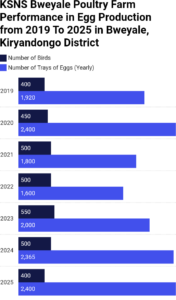
Nakazi’s poultry numbers show progress. In 2019 she kept 400 birds and got 1,920 trays of eggs. By 2025, 400 birds gave her 2,400 trays of eggs. Since February this year, 450 birds have given at least 13 trays per day. She is assured of sustained income.
Like Nakazi, Sarah Baterengaya, another farmer is banking weekly profits: “I am able to save up to 52,000 UGX weekly from the project. It has helped me clear school fees for my children, which was not the case before.”
KSNS Bweyale Poultry Farm Performance in Egg Production from 2019 To 2025
Renewed Hope
For refugees in Kiryandongo Refugee Settlement, the demand for woodfuel for cooking is unmatched and difficult to satisfy as tree covers in and around the settlement have been decimated for Charcoal business.
Interestingly, Poultry waste can be processed in biogas digesters to generate renewable energy for cooking and lighting. Such technologies are already being piloted around the settlement in view of reducing its methane emissions footprint while providing electricity or cooking fuel.
Fatima Babiker Mohammed, the Manager at Khafa Poultry Farm, says “As a refugee, I thought everything had ended after we were forced out of our homes by conflict. But I have found a new life through poultry. My livelihood has significantly improved and I have ventured into other projects as well.”
Osaman Saleh, another refugee from Sudan, says his experiences have grown over time: “We have learnt a lot about birds. We have a lot to do to reach 500 trays a day, our ultimate target. We would like to reach more refugees with employment.”
Among the refugees, determination to introduce a new strand of peace in the conflict in South Sudan and the Sudan respectively. They believe that sustainable investment will dramatically solve the resource conflict back in their countries.
But there are still many barriers before all ammunition manufacturing factories are replaced with poultry feed or veterinary manufacturing. Sarah Babirye advised the farmers to keep diversifying their sources of income beyond the single cash cow in poultry as prices of eggs can fluctuate below profit levels amidst high costs of feed.
Dr. Wabwire Tonny, the Kiryandongo district veterinary officer, is a committed poultry farmer himself. He is keeping 1,200 layers in his pence. “It’s expensive to raise layers for the first 4 months of life. A layer eats 8kg of feed a day to point-of-lay.” He explained.
With 500 birds, an average farmer will require up to 600,000 Uganda shillings for feeds a month. To be profitable, Dr. Wabwire advises farmers to keep between 250 – 500 layer birds. “My farm operates at 90% production, 35 trays daily from the 1,200 birds. Once a farmer follows instructions, production becomes sweet,” he says.
Continuous Training
Bweyale Vet Centre trains farmers on debeaking, hygiene, and treatment, and does daily monitoring. Dr. Wabwire warns against mistakes: don’t over-treat, avoid free entrance, use a foot dip at the door, and don’t overfeed because it makes birds obese.
The district has two approved vet centres: Bweyale Vet Centre and Kigumba Vet Layers. Farmers are told to carry monthly vaccine cards to avoid double dosing and to call extension workers.
Demand is not the problem. Mbabazi Evas, an egg consumer at Bweyale Market, says: “Many people prefer eggs to meat because it is easy to prepare and cheaper for low income households. If there are plenty, I could buy at least 5 trays in a week.
Tuhaise Monica, a shopkeeper in Kiryandongo Town Council, confirms the gap: “There is a lot of market for eggs. The challenge is the few suppliers who can’t keep to the demand of the market. My main supplier, Bweyale Vet, is not enough. I could sell 50 trays a day, but it’s hard to get a consistent agent who can supply the 50 trays daily.”
Awoke Juliet speaks for mothers: “Health workers advised me to feed my children eggs daily for better performance in class.”
From Sudan to Bweyale, from refugee to host community, layers are changing livelihoods household by household. Community by community. The birds are not the farmers’ luck in themselves. They are training, structure, and group work and a market that is still hungry for more eggs.
This story was produced with support from Climate Smart Jobs in partnership with InfoNile.
Do you have an advertisement or article you want to publish? Mail us at theugreports@gmail.com or WhatsApp +256757022363.