Mbale Regional Referral Hospital trains senior staff on medical negligence, professional conduct
The training featured presentations from several consultants on professional competence, ethics, and legal responsibilities in healthcare practice.

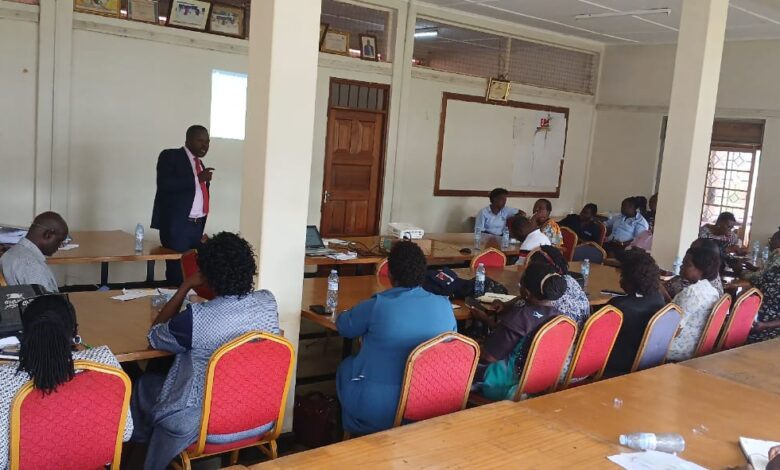

Mbale: Mbale Regional Referral Hospital has intensified efforts to improve healthcare service delivery through continuous staff capacity building, with senior consultants, heads of departments, and health professionals undergoing training on medical negligence, medical law, and human resource management.
The training was conducted as the hospital received departmental reports and concluded activities for the March quarter and the financial year.
Speaking during the training, Dr. Stephen Obbo, the Hospital Director emphasized the importance of continuous professional development for staff at the referral hospital and health facilities across the Elgon sub-region and beyond.
“Capacity building is important because it reminds healthcare professionals of their roles and responsibilities. Departmental meetings are mandatory, and we shall continue investing in training to improve service delivery in line with government health objectives,” the director said.
He noted that Mbale Regional Referral Hospital’s strong performance and high rankings have largely been attributed to regular staff training and professional development initiatives.

The training featured presentations from several consultants on professional competence, ethics, and legal responsibilities in healthcare practice.
Among the facilitators was Steven Masiga, spokesperson of the Bugisu Cultural Institution and a legal consultant, who delivered a presentation on medical negligence and the legal consequences of professional misconduct in healthcare.
Masiga explained that medical negligence occurs when a healthcare professional fails to provide the standard of care expected under similar circumstances, resulting in injury or worsening a patient’s condition.

“Medical negligence occurs when a healthcare worker provides treatment that falls below acceptable standards of care, causing harm to a patient. It can also involve failing to do something that a careful and competent professional would ordinarily do,” Masiga said.
He cited examples of negligence, including surgical errors such as leaving medical materials inside patients during operations and failures in communication between medical personnel and patients.
Using both local and international case studies, Masiga highlighted the legal and financial consequences of negligence in healthcare settings.
Referring to the case of Sarah Watsemwa versus the Attorney General, he noted that government paid more than Shs500 million in compensation following negligent conduct by health workers at Mulago National Referral Hospital.
According to Masiga, the plaintiff had reported to the hospital for delivery, but improper medical procedures resulted in complications that caused irreversible brain damage to her child.
“The case demonstrates the importance of adhering to professional standards and established medical procedures. Negligence can have lifelong consequences for patients and significant financial implications for government institutions,” he said.
He also cited the case of John Wataka versus The AIDS Support Organization (TASO), where a patient was wrongly diagnosed as HIV positive and subjected to treatment before later discovering he was HIV negative.
“The court awarded substantial compensation because of the emotional and psychological suffering caused by the misdiagnosis,” Masiga noted.
To further emphasize the importance of professionalism, Masiga shared an international case from India where a patient died after being connected to an empty oxygen cylinder due to negligence by healthcare workers.
“These are unfortunate situations, but they provide valuable learning points. Every incident in medicine should be an opportunity to improve systems and prevent future mistakes,” he said.
Masiga urged healthcare workers to remain faithful to the professional oath they take upon graduation and to prioritize effective communication with patients.
“Good communication between healthcare workers and patients is critical. Many medical disputes arise not only because of treatment outcomes but also because of poor communication,” he added.
The training brought together consultants and heads of departments from Orthopaedics, Obstetrics and Gynaecology, Internal Medicine, Paediatrics, Ophthalmology, Community Health, Emergency Services, Human Resource Management, and representatives from development partners including FHI 360.
Hospital Planner Tom Wanasolo, who chaired the session, received departmental reports from various units and commended the partnership between the hospital and the Bugisu Cultural Institution.
“Mr. Steven Masiga has supported us in legal capacity building for the last three years. Whenever the need arises, we call upon him to share his expertise with our staff,” Wanasolo said.
Hospital officials said such trainings will continue as part of efforts to strengthen professionalism, reduce medical errors, and improve the quality of healthcare services offered to patients across Eastern Uganda and neighboring regions.
Do you have an advertisement or article you want to publish? Mail us at theugreports@gmail.com or WhatsApp +256757022363.