West Nile leaders trained on nominating Individuals for National Honors and Awards
Award recipients enjoy recognition at national and state events, priority access to key public services (e.g., hospitals, banks) and invitations to both state and community functions.

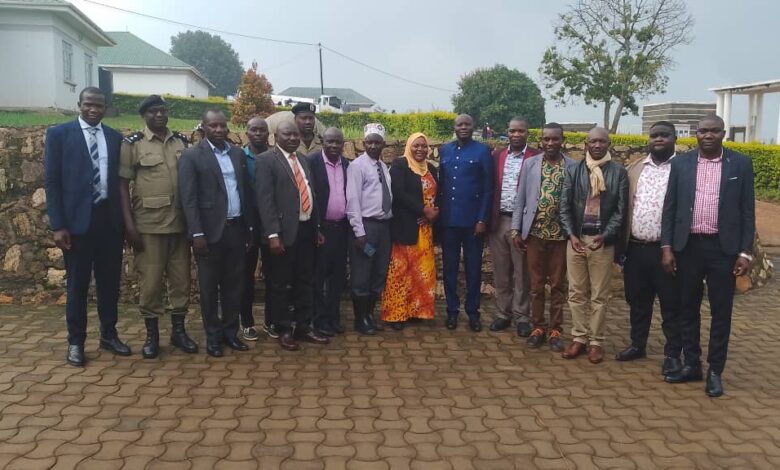

Zombo: Leaders across the West Nile sub-region have received training on how to identify and nominate outstanding individuals for Uganda’s annual national honors and awards, which are conferred by President Yoweri Museveni.
The training was conducted on August 22, 2025, at the Zombo District Headquarters, and led by Hajjat Zaminah Malole, Secretary of the Presidential Awards Committee. Her presentation, titled “National Honours and Awards and the Role of District Leadership in Their Administration”, focused on the nomination process and the vital role of local leaders.
“We’ve been in this region since Monday, meeting different leaders to sensitize them about the national honors and awards—especially the nomination criteria,” Malole said in an interview.
“We work closely with them when identifying people worthy of recognition by His Excellency the President of the Republic of Uganda.”
Malole emphasized the key role of Resident District Commissioners (RDCs) and district security committees in recommending individuals who have significantly contributed to Uganda’s development across sectors such as education, health, security, agriculture, and leadership.
Uganda’s national honors tradition dates back to 1962, with the institution of the Uganda Independence Medal by Queen Elizabeth II to commemorate the country’s independence. This medal recognized distinguished public service in the military, police, and local government.
Under Article 98 of the 1995 Constitution of Uganda, the President is the Fountain of Honour, with the exclusive authority to bestow national titles. This framework is supported by the National Honours and Awards Act, 2001 (as amended), and the National Honours and Awards Regulations, 2014, which outline procedures, nomination guidelines, and award entitlements.
Festus Ayikobua, the RDC for Zombo District, described the training as enlightening, admitting he had previously lacked full understanding of the nomination process. He pledged to actively support the identification of deserving individuals.
Hassan Ringtho, Zombo District Council Speaker, representing the LCV Chairperson, acknowledged that many leaders were previously unaware of the honors system despite having witnessed awards being conferred. He cited Oyullu Vincent as one individual worthy of national recognition for his contributions to Zombo’s development.

Fred Chothembu, representing the Chief Administrative Officer (CAO), stressed the importance of recognizing retired public servants who have contributed honorably to the region’s growth.
District leaders are now expected to identify and nominate individuals who have made outstanding contributions to national development, accurately complete and submit nomination forms for consideration, act as ambassadors of excellence, encouraging citizens to strive for national distinction and educate the public on the significance and criteria for national honors.
Operating under the Office of the President, the Chancery led by the Minister for the Presidency and the Secretary of the Presidential Awards Committee is responsible for administering and safeguarding national honors, conducting background research on nominees, presenting vetted nominations to the President and maintaining the Mini Hall of Fame (launched in 2021), which showcases honorees’ profiles, photographs, and memorabilia.
Award recipients enjoy recognition at national and state events, priority access to key public services (e.g., hospitals, banks) and invitations to both state and community functions.
However, Section II of the National Honours and Awards Act, 2001 empowers the President to revoke awards if a recipient is found guilty of fraud, misrepresentation, or moral misconduct. In such cases, honorees are required to return their medals within one month, or risk fines and/or imprisonment.
The awards framework is aligned with National Development Plan III (NDP III), which promotes incentives for exemplary citizens and the NRM Manifesto, which emphasizes value systems, patriotism, and national unity.
Hajjat Malole concluded by urging local leaders to apply their newfound knowledge to nominate deserving individuals in their communities.
“This training has equipped leaders across West Nile to fulfill their role in the national honors process. It’s now their responsibility to ensure that outstanding citizens are recognized for their service to Uganda,” she said.
Do you have an advertisement or article you want to publish? Mail us at theugreports@gmail.com or WhatsApp +256757022363.