‘Justice for Her’ Project launched in Nebbi to fast-track Gender-Based Violence Cases
Stakeholders stress the transformative potential of such reforms in dismantling patriarchal norms and addressing systemic inequalities that fuel GBV.

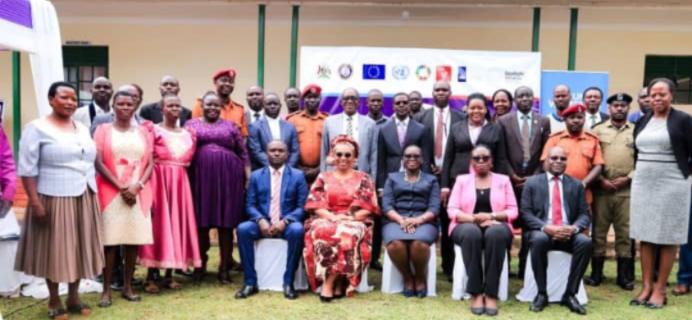

Nebbi: In a landmark move to strengthen Uganda’s judicial response to gender-based violence (GBV), Hon. Lady Justice Okuo Jane Kajuga, the Acting Principal Judge, officially launched the “Justice for Her” project at the Nebbi High Court Circuit.
Formally known as the Judiciary Time-Share Fast-Track Mechanism for GBV Cases, the project is designed to accelerate the resolution of GBV-related cases, improve support for victims, and expand access to justice for women and girls throughout the country.
Supported by UN Women and the Austrian Development Cooperation, and implemented in the High Court circuits of Nebbi, Gulu, and Masaka, the initiative aims to tackle systemic delays in GBV cases, foster gender-sensitive legal processes, and enhance survivor-centered services.
During a high-level stakeholders’ meeting prior to the launch, partners reviewed implementation timelines, resource allocation, and a robust monitoring and evaluation (M&E) framework.
Ms. Adekemi Ndieli, Deputy Country Representative for UN Women, emphasized the importance of investing in court digitization and deploying dedicated M&E officers to enable virtual GBV hearings, increasing accessibility and efficiency.

“This initiative is not merely procedural,” said Hon. Lady Justice Kajuga. “It is a commitment to deliver justice to those most in need. By July, we expect measurable progress to facilitate effective monitoring and accountability.”
She acknowledged support from the Austrian Development Cooperation, UN Women, and the Kingdom of the Netherlands, confirming an allocation of UGX 350 million to the project.
GBV in Uganda remains one of the gravest public health and human rights challenges. Defined under the 1993 UN Declaration on the Elimination of Violence Against Women, GBV includes acts of physical, sexual, or psychological harm or suffering whether in public or private life.

Uganda’s data paints a sobering picture indicates that 51% of women aged 15–49 have experienced physical violence (UDHS 2022), 17% reported sexual violence in the past year and 95% of women and girls have faced violence since age 15 (VAWG 2020).
The 2023 Police Crime Report recorded 15,184 domestic violence cases, with over 11,000 female victims, including 644 juvenile girls.
The COVID-19 pandemic further exacerbated GBV, contributing to spikes in teen pregnancies, early marriages, and school dropouts especially in rural communities.
The “Justice for Her” project aims to Fast-track GBV cases, reducing judicial backlog, improve conviction rates through specialized court sessions in Nebbi, Gulu, and Masaka and also to enhance victim experiences with trauma-informed and survivor-centered judicial practices.
Stakeholders stress the transformative potential of such reforms in dismantling patriarchal norms and addressing systemic inequalities that fuel GBV.
Hon. Lady Justice Harriet Grace Magala, Resident Judge of Arua High Court, reaffirmed the judiciary’s commitment and advocated for the formal establishment of the Nebbi High Court to ensure lasting judicial access in the region.
Mr. John Paul Edoku, representing the National Registrar, lauded the dedication of judicial officers in Nebbi and neighboring districts, while extending appreciation to development partners for their continuous support.
The event drew attendance from Uganda Police, justice sector officials, human rights advocates, religious and cultural leaders, and community members.
Mr. Deo Akugizibwe of the Judiciary presided over the proceedings, and Chief Magistrate Cyrus Ssennoga Mawano was recognized for revamping court archives with acid-free storage—an improvement in case management and judicial efficiency.
A Step Toward Justice and Equality
The “Justice for Her” project represents a powerful shift toward timely, inclusive, and accountable justice for survivors of GBV. Through judicial innovation, strategic partnerships, and community-driven advocacy, the initiative aligns with Uganda’s National Development Plan III, which seeks to reduce GBV prevalence by 30% by 2025.
As the project gains momentum in Nebbi, Gulu, and Masaka, its success could lay the groundwork for nationwide replication ensuring no survivor is denied justice due to delay or discrimination.
Do you have an advertisement or article you want to publish? Mail us at theugreports@gmail.com or WhatsApp +256757022363.