Judiciary champions alternative dispute resolution as key to community harmony
These include mediation, arbitration, negotiation, and community-led reconciliation.


Mbale: The Judiciary of Uganda has stepped up efforts to promote Alternative Dispute Resolution (ADR) as a key method for resolving community disputes across the country.
This push follows the official launch of the national ADR strategy in 2023 in Kampala, marking a shift towards more accessible, culturally rooted, and community-centered justice.
Speaking recently in Mbale, the Court Registrar called upon judges, lawyers, and court users to prioritize ADR over formal litigation in suitable cases. He emphasized that not every conflict belongs in court, especially when communities have capable structures such as cultural institutions, elders, and churches that can help mediate and resolve disputes peacefully.
“We must allow courts of law to focus on sensitive and complex cases, while community-based mechanisms handle everyday disputes,” the registrar said.
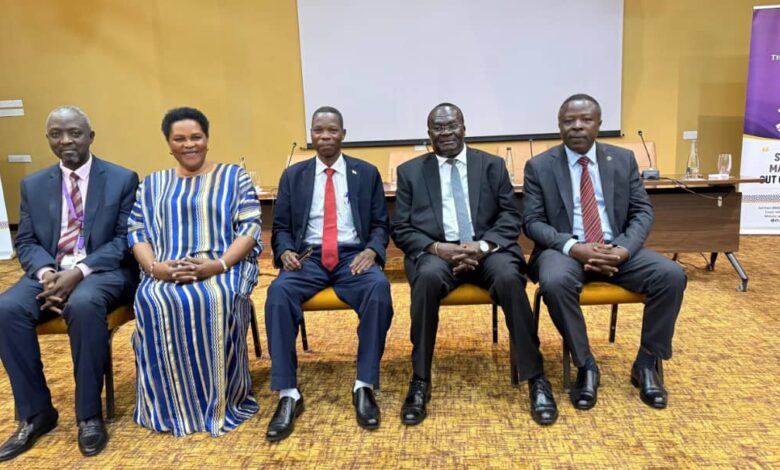
At a recent summit in Munyonyo, Chief Justice Alfonse Owiny-Dollo addressed a special delegation from the Bamasaaba Cultural Institution, which included Mr. Steven Masiga the Spokesperson, Hon. Kutoi Moses, the Minister for Culture, and Hon. Irene Manghali, the Special Envoy of the Umukuka.

He praised the ADR model and cited Zambia and Namibia as successful examples where alternative justice systems have significantly reduced court case backlogs and promoted healing and reconciliation in communities.
“Litigation often creates winners and losers, but ADR fosters dialogue, understanding, and long-term peace,” he stated.
ADR, broadly defined, is a non-adversarial method of resolving disputes outside traditional courtrooms. These include mediation, arbitration, negotiation, and community-led reconciliation.
The Ugandan Constitution, under Article 126(2)(d), supports the use of alternative justice mechanisms, particularly those that promote reconciliation, healing, and unity within communities. The growing momentum around ADR is also backed by research showing that 90% of disputes can be resolved through ADR, drastically reducing the burden on courts.
During the ADR National Summit in Munyonyo, participants including judiciary officials, ministers, the Director of Public Prosecutions (DPP), and religious and cultural leaders unanimously resolved to archive the Bukuka mediation process as a model precedent for cultural institutions across the country.
The Bukuka leadership dispute within the Bamasaaba Cultural Institution was successfully resolved in 2023 through a collaborative process involving the High Court in Mbale, the Ministry of Gender, Labour and Social Development, and cultural elders. This was legally anchored under Article 246(2) of the Constitution and Section 16(1) of the Traditional and Cultural Leaders Act. The resolution led to the gazettement of Umukuka III, Jude Mike Mudoma.
“The Bukuka resolution shows how traditional structures can resolve complex leadership issues without prolonged litigation,” said a representative from the Bamasaaba delegation.
The Judiciary’s endorsement of ADR signals a new era in Uganda’s justice system—one that emphasizes community cohesion, cultural relevance, and faster access to justice. With support from both the judicial system and cultural leaders, ADR is emerging as a powerful tool for conflict transformation and nation-building.
Do you have an advertisement or article you want to publish? Mail us at theugreports@gmail.com or WhatsApp +256757022363.